Showing posts with label CFD. Show all posts

Wednesday, October 25, 2017

Understand the Cooling and Ventilation System Design for Data Center


Air Conditioning System Design for Data Center
(23 - 24 March 2017, approved CPD course by CIBSE UK)


It targets to engineers involved in designing or handling HVAC (Heating, Ventilation and Air Conditioning) equipment for mission critical facilities, IT infrastructure and data center projects.

All sessions highlight design principles such as psychrometric chart, cooling load calculation / estimation, etc. and the design considerations such as air distribution, availability / redundancy, common mistakes, Computer Fluid Dynamic (CFD) model, integration with MEPs (Mechanical, Electrical and Plumbing system), etc.

You'll be able to make informed decisions about the best choices of cooling systems for mission critical purposes and how system can best meet the project goal and SLA (Service Level Agreement).


Date: 23 - 24 March 2017 (Thursday - Friday)
Time: 10:00 - 17:30
Venue: 14/F, On Lok Yuen Building, 25-27A Des Voeux Road Central, Hong Kong
Fee: Special rate for CIBSE / HKIE all membership classes


> Datacom Equipment Power Trends and Cooling Applications

-- Load trends and their application
-- Air cooling of computer equipment
-- Liquid cooling of computer equipment


> Design Consideration

-- Design criteria
-- HVAC load
-- Computer room cooling
-- Air distribution
-- Liquid cooling
-- Availability and redundancy
-- Controls
-- Integration with other MEP (Mechanical, Electrical and Plumbing) system
-- Computer Fluid Dynamics (CFD)


> Testing and Commissioning

-- Air cleanliness test
-- Heat load test
-- Factory acceptance test
-- Site acceptance test
-- Integrated performance test (IST)


> Energy Efficiency

-- Power usage effectiveness
-- Chilled water plant optimization
-- Water side and air side equipment
-- Part load operation
-- Controls and energy management
-- LEED certified data center
-- Building energy code


> Sustainable Design

-- Combined heat power plant (CHP)
-- Solar cooling
-- Geothermal cooling
-- Evaporative cooling
-- Air side economizers
-- Desiccant unit


For details, please visit http://www.stmedia-asia.com/newsletter_6.html.


Get Ready to Become a Registered Specialist Contractor (Ventilation)
(29 April & 6 May 2017, Saturday)


Designed for enterprises in ventilation / air-conditioning engineering - Technical Director (TD), Authorized Signatory (AS) or other officers, our speaker introduces the register requirement, interview technique, Buildings Ordinance, ventilation and fire safety, occupational safety, health and environmental protection, etc.

The preparatory course helps local engineers and enterprises to facilitate compliance with the Buildings Ordinance in Hong Kong and to get ready to become a Registered Specialist Contractor for Ventilation Works (RSC-V).


Date: 29 April + 6 May 2017 (Saturday) - 11th round
Time: 9:00 - 13:00 / 13:30
Venue: 14/F, On Lok Yuen Building, 25-27A Des Voeux Road Central, Hong Kong
Fee: Early bird discount available for payment & application made before March 17, 2017


The RSC-V preparatory course is also available online www.stmedia-asia.com/aircon.html.


About us


Strategic Media Asia (SMA) is one of the approved CPD course providers of the Chartered Institution of Building Services Engineers (CIBSE) UK. The team exists to provide an interactive environment and opportunities for members of ICT industry and facilities' engineers to exchange professional views and experience.

SMA connects IT, Facilities and Design. For the Data Center Consideration Series, please visit 


(1) Site Selection,
(2) Space Planning,
(3) Cooling,
(4) Redundancy,
(5) Fire Suppression,
(6) Meet Me Rooms,
(7) UPS Selection, and
(8) Raised Floor

All topics focus on key components and provide technical advices and recommendations for designing a data center and critical facilities.


Tuesday, January 24, 2017

Data Center Design with Building Information Modeling (BIM)


Data center design involves a lot of timing of schedules, organization, tracking of materials and changes, etc. with complex design teamwork and coordination. For this reason, the process of Building Information Modeling (BIM) is introduced to facilitate and streamline data center project designs:


Better project coordination

BIM allows everyone - architects, electrical and mechanical engineers, project managers, etc. - involved in the project to input their data into the shared model. Information is kept in one place, which helps with communication and project coordination. 


Faster fault detection and assessing problems

Using 3D computer models allows the project team to detect and evaluate errors or fault easily that could cause an issue during construction. Your mission-critical building is shown in scale, and you are able to enter manufacturer details / data into a 3D model, visualizing the whole project and important issues during the design.


Deeper design preparation with improved management

Data centers is designed for large amounts of IT equipment supported by critical facilities (MEP - mechanical, electrical, plumbing equipment). All of these equipment & facilities have high power consumption. They must be fit properly, have proper distribution and suit certain service clearances. The routing of BIM allows electrical & mechanical (EM) designers and structured cabling system designers ( for optical fiber, high voltage / low voltage cables, etc.) to know exactly where to model for heat dissipation and adjust for any electrical duct work, and allows engineers to adjust for proper air flow.


For the raised-floor, it can be especially tricky. Most floor installers do not model their installations — adjustments for structural bridging and support are typically made in the field. Creating a BIM model of the flooring allows the installer to understand where the MEP systems are located in relationship to the pedestal support systems.Flooring installers can see where they need to modify their support framing early in the process and fabricate the necessary bridging and support components to span across the MEP systems where necessary. This eliminates the time and effort it would take to do this in the field once the MEP systems are installed, thus decreasing the field installation time.

By incorporating computational fluid dynamic (CFD) simulations into the BIM model, engineers can evaluate and fine tune server layouts based on the thermal modeling. You’re able to visualize how the air will flow inside the data center and see the temperature variation based on the height and how the air is moving. It’s especially helpful in being able to see how the servers in a computer room receive cold air and how hot air is removed (hot aisle & cold aisle).


Smoother commissioning and operations & maintenance (O&M) tasks

Data centers require a series of precise commissioning process to ensure performance and reliability. Commissioning information tags for each piece of equipment and feeder can be added to the BIM model to keep a live database of commissioning process status. These information are so valuable to the operational staff, such as submittals, O&M manuals, as-built plans, balancing reports and commissioning reports. When this information is inserted into the BIM database, the information can be retained and viewed for each piece of equipment, rather than in separate volumes. Data center operators would benefit from a comprehensive set of information.


Source: BICSI - BIM in Data Center Design (www.youtube.com/watch?v=u3ExZq-3iMA)


About us


Strategic Media Asia (SMA) is one of the approved CPD course providers of the Chartered Institution of Building Services Engineers (CIBSE) UK. The team exits to provide an interactive environment and opportunities for members of ICT industry and facilities' engineers to exchange professional views and experience.

SMA connects IT, Facilities and Design. For the Data Center Consideration Series, please visit 


(1) Site Selection,
(2) Space Planning,
(3) Cooling,
(4) Redundancy,
(5) Fire Suppression,
(6) Meet Me Rooms,
(7) UPS Selection, and
(8) Raised Floor

All topics focus on key components and provide technical advices and recommendations for designing a data center and critical facilities.


Tuesday, September 15, 2015

Course in Air Conditioning System Design for Data Center


A data center houses hundred / thousand of IT equipment and servers for mission critical purpose. These IT facilities consume large amount of energy and generate heat during operations. Particular cooling strategies and power system design are therefore required for a data center.


This is an advanced learning section for data center design. It targets to engineers involved in designing or handling HVAC (Heating, Ventilation, and Air Conditioning) equipment for mission critical facilities and data center projects.


We introduces various classifications of HVAC systems and the associated distribution systems for mission critical facilities. Each system type is evaluated based on the performance for energy efficiency, water use and comfort performance. Participants are able to make informed decisions about the best choices of cooling systems for mission critical applications and how system can best meet your project goal and SLA (Service Level Agreement).


The course highlights design principles such as psychrometric chart, cooling load calculation / estimation, etc. and the design considerations such as air distribution, availability and redundancy, common mistakes, Computer Fluid Dynamic (CFD) model, integration with MEPs (Mechanical, Electrical and Water Plumb), etc.


Overall we train participants to understand different factors, from design, testing, commissioning, sustainability and efficiency, that significantly impact the cooling system of data centers.


  • Datacom Equipment Power Trends and Cooling Applications
    • (a) load trends and their application
    • (b) air cooling of computer equipment
    • (c) liquid cooling of computer equipment

  • Design Consideration
    • (a) design criteria
    • (b) HVAC load
    • (c) computer room cooling
    • (d) air distribution
    • (e) liquid cooling
    • (f) availability and redundancy
    • (g) integration with other MEP system
    • (h) controls
    • (i) computer fluid dynamics

  • Testing and Commissioning
    • (a) air cleanliness test
    • (b) heat load test
    • (c) factory acceptance test
    • (d) site acceptance test
    • (e) integrated performance test (IST)

  • Sustainable Design
    • (a) combined heat power plant (CHP)
    • (b) solar cooling
    • (c) geothermal cooling
    • (d) evaporative cooling
    • (e) air side economizers
    • (f) desiccant unit

  • Energy Efficiency
    • (a) power usage effectiveness
    • (b) chilled water plant optimization
    • (c) water side and air side equipment
    • (d) part load operation
    • (e) controls and energy management
    • (f) LEED certified data center
    • (g) building energy code


    For registration and course details, please visit www.stmedia-asia.com/newsletter_6.html.

    "Air Conditioning System Design for Data Center" is an approved CPD course by Chartered Institution of Building Services Engineers (CIBSE).


    About the Organizer - SMA


    Strategic Media Asia Ltd (SMA) is one of the Approved CPD Course Providers of the Chartered Institution of Building Services Engineers (CIBSE). SMA exists to provide an interactive environment and opportunities for members of IDC industry and engineers to exchange professional views and experience on data center design, critical infrastructure system, electrical and mechanical facilities, etc.

    SMA connects IT, Facilities and Design. For details, please visit our website at www.stmedia-asia.com/trainings.html.


    Monday, October 28, 2013

    Now for Sale - Training Manual of "HVAC Design and Cooling Specialist for Data Center Efficiency"


    HVAC DESIGN & COOLING SPECIALIST FOR DATA CENTER EFFICIENCY


    This is a training manual developed by a team of experienced Chartered Engineers (CEng). For data center operators and facilities managers, we help you to understand key challenges and consider different factors, from design, testing, commissioning, sustainability and efficiency, of HVAC (Heating, Ventilation, and Air Conditioning) system for data centers.

    In addition, the manual details the guidelines of data centers’ cooling criteria, HVAC load development, air distribution, liquid cooling, contamination, availability and redundancy, Computer Fluid Dynamic (CFD) model, energy efficiency, etc., from general theory to technical implementation.

    To predict a data center’s power and heat loads over the years ahead is the hardest thing for data center owners. It introduces datacom power trends and cooling applications showing expected growth in power density for different types of computing equipment out to 2020.


    Total Number of Page: 106
    Total Number of Slide Contained: 204
    Size: 210mm x 300mm x 10mm
    Language: English
    Color: Black & White
    CD / Soft Copy: Not Included

    THE MANUAL CONTENT


    Datacom Equipment Power Trends and Cooling Applications

    (a) load trends and their applications
    (b) air cooling and liquid cooling of computer equipment

    Design Consideration

    (a) design criteria and HVAC load
    (b) computer room cooling and air distribution
    (c) liquid cooling
    (d) availability and redundancy
    (e) integration with other MEP system
    (f) controls and computer fluid dynamics

    Testing and Commissioning

    (a) air cleanliness test, heat load test
    (b) factory acceptance test and site acceptance test
    (c) integrated performance test (IST)

    Sustainable Design

    (a) combined heat power plant (CHP)
    (b) solar, geothermal and evaporative cooling method
    (c) air side economizers
    (d) desiccant unit

    Energy Efficiency

    (a) power usage effectiveness (PUE)
    (b) chilled water plant optimization
    (c) water side and air side equipment
    (d) part load operation
    (e) controls and energy management
    (f) LEED certified data center
    (g) building energy code


    ORDER METHOD

    Please contact us at info@stmedia-asia.com
    The manual is also available on eBay: http://www.ebay.com/usr/st-media


    Monday, February 18, 2013

    Data Center CFD Modeling becomes user-friendly

    Over the past several years, Computational Fluid Dynamics (CFD) modeling has proven to be a reliable method for optimizing the energy efficiency of the data center as well as accurately predicting the failure-mode conditions associated with cooling system failure.

    For the past 30 years, CFD has been heavily used in industries such as aerospace and F1 racing, as the systems are complex, exotic and expensive. But things are beginning to change. Using advanced graphical user interfaces (GUIs) combined with a “SaaS” (software as a service) methods of application delivery, data center designers and facility managers are able to use the same technology to design data centers that the Ferrari F1 team uses to design its race cars, and at a much lower cost of entry. This approach greatly broadens access to this technology, which has been well proven in optimizing energy efficiency, reducing hot spots and accurately predicting cooling failure.
     

    Benefits of CFD Monitoring

     
    PUE Prediction
     
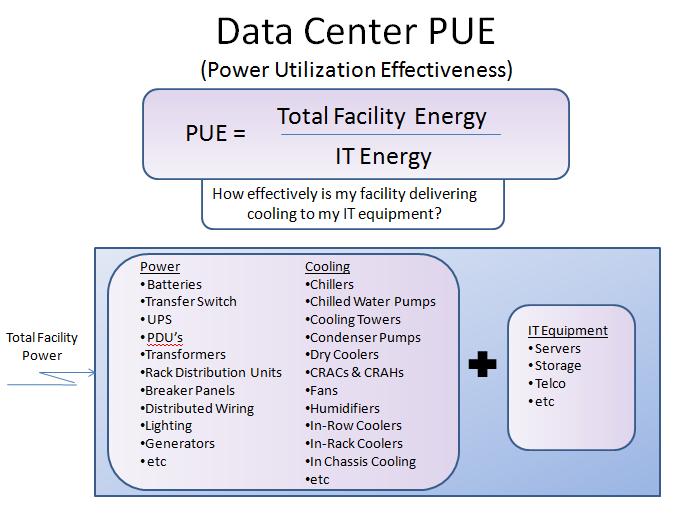
    The energy to power a data center is composed of the power to drive the servers plus the power to cool the servers and any other ancillary devices such as PDUs, pumps and lighting. A common method for measuring the energy efficiency of a data center is PUE (power utilization effectiveness). The PUE of a data center is expressed in the relationship shown in Figure 1. A “good” data center is represented by a PUE of 1.2 or lower, suggesting that an additional 20% of the total power to operate the data center is powering non-IT equipment.
     
     
    When reviewing the items that constitute the non-IT components of the calculations, the dominant parameters are related to the power required to drive the cooling systems. The role of CFD modeling in any of these designs is to insure that the cool air coming from the ducts, tiles or CRAH outlet reaches all the servers uniformly. This process of modeling the airflow and the resulting convective heat transfer is essential to the overall design and operation of a data center, particularly as it relates to failure-mode studies.
     
    Cooling Failure Prediction
     
    Failure model prediction is a key benefit that CFD modeling can provide. All cooling units need to be serviced periodically, and they completely fail occasionally. Predicting the thermal condition of the room ahead of the failure is vitally important to the data center operator. Knowing which servers will need to be shut down, or which cooling units are the most critical to the room, can be accurately and precisely predicted well in advance, and procedures can then be developed to follow in those cases.


    What to Look for in a CFD Model

     
    Here are some key factors to consider when seeking a CFD model:
     
    • User friendly: The last thing you need is another complex system—be sure to choose a model that is easy to use, is easy to understand and can be easy displayed to others (such as the C-Suite) who may not be as tech savvy.
    • Scalability: Be sure to choose a solution that will scale with you as new components (files, CRACs, racks, tiles, servers and so on) are added.
    • Cloud-Based: The cloud enables lower upfront investment, as it doesn’t require a dedicated server in your data center.
    • Flexible and Extensible: Be sure the system is flexible and extensible for integration with either upstream or downstream applications. For example, data from other DCIM applications can be fed directly into the system to speed model preparation.
    • Maximum Output: Look for a system that has options for output reports to ensure variety in how the information can be presented (graphs, charts, etc.). Every organization has its own methods, and this feature will benefit the usefulness of the data—it is meaningless unless it can convey the message to decision makers.

    Adopted from http://www.datacenterjournal.com