Showing posts with label Tier III. Show all posts

Thursday, March 12, 2020

Electrical Distribution System in a Data Center


There are many different loads in the data center, such as IT devices, air conditioners (CRAC Units), pumps, lighting, etc. The critical supply from the utility / transformer / generator to the load is enabled by various types of power equipment. We are going to illustrate these equipment that are critical and without which it would not be possible to operate the data center.

Figure 1 is a block diagram of an electrical distribution system showing the name and the typical location of the electrical distribution equipment in a data center and the power flow path (Uptime Institute Tier Level II, N+1 Design) . This diagram is only an example of an electrical architecture and attempts to include all the possible major types of equipment used and their typical location in a data center. In the real world, a typical data center electrical design has much more complexity and diversity than that in this diagram.


Uptime Institute Tier II, N+1 Design

Figure 1 

Uptime Institute Tier III Design

Uptime Institute Tier IV, 2N+1 Design


Tracing the flow of power along its path (starting from the utility to the IT load) in the figure 1 above. It shows 8 essential facilities are critical for the power supply. This facilities distribute power to the downstream loads and also protect the power distribution system in the data center:

  • Medium-voltage switchgear
  • MV/LV transformer
  • Low-voltage switchgear / switchboard / automatic transfer switch (ATS)
  • UPS system with input/output switchboard and UPS distribution switchboard
  • Power distribution Units (PDUs) and remote power panels (RPPs)
  • Busway
  • Panelboard
  • Rack PDUs (rPDUs) / outlet strips


All facilities above, except for rack PDUs (rPDUs), are considered to be assemblies containing circuit breakers, switches, various types of relays, buses and connections, and control and auxiliary devices. Each device is optimized for long life and ease of maintenance.

The IEC 61947 & IEC 62271, which specifies the HV and LV switchgear terminology, considers switchboard to be the same as switchgear. For some regions like, North American, switchgear and switchboard are specified differently by ANSI and UL standards.


About Us


SMA combines with professional Chartered Engineers (CEng) from the Institute of Engineering Technology (IET), the Chartered Institute of Building Services Engineers (CIBSE) and the Hong Kong Institution of Engineers (HKIE). Our engineers have more than 20 years experience in data center design & build, building services engineering and energy conservation in the private and public sectors.

The team prepares the engineers and IT personnel to face any challenges in data centers and critical facilities of any size, in any location. For other design considerations / topics in data center and critical infrastructure, please visit 


(1) Site Selection,
(2) Space Planning,
(3) Cooling,
(4) Redundancy,
(5) Fire Suppression,
(6) Meet Me Rooms,
(7) UPS Selection,
(8) Raised Floor,
(9) Code & Standards,
(10) Transformers and Harmonic Distortion,
(11) Multi-mode UPS Systems,
(12) Electrical Rooms,
(13) Generator Systems,
(14) Generator Fuel Systems,
(15) Battery Systems,

(16) Earthing / Grounding and Bonding, etc.


Monday, October 29, 2018

"Tier 3+" or "Tier 4-Ready" Data Centers?


This is usually found in some data center specifications: "Tier III+" or "Tier IV-Ready" *

Let's clarify: There is no such thing as "Tier III+" or "Tier IV-Ready" for large data centers. They are not granted by any organizations in data center / critical facilities like Uptime Institute or Telecommunications Industry Association (TIA) - ANSI/TIA-942 **.


* The latest TIER IV-Ready Certification by the Uptime Institute is designed for modular data centers which enjoy the same level of reliability and resiliency that they have in their larger data centers.

** The term ‘Tier’ was used in the ANSI/TIA-942 Standard until the ANSI/TIA-942: March-2014 edition. In the March 2014 edition the term ‘Tier’ has been replaced by either ‘Rated’ or ‘Rating’.


Recap (1) More about Data Center Tier Levels; and
(2) Data Center Tier Levels and Uptime


The Uptime Institute issues Tier Certificates (Constructed Facility and Design Documents) for data center infrastructure. When a data center is accredited as Tier III Constructed Facility, the infrastructure, at the time of the site visit and demonstrations, should be "Concurrently Maintainable" and N+1 (N means Utility Power) with 1 active + 1 alternate distribution paths (electrical power backbone) and 2 simultaneously active critical power distribution.

One of the major different between Tier III and Tier IV infrastructure is the requirement of Distribution Paths - Electrical Power Backbone. Tier IV facilities require 2N / 2N+1 which means 2 electrical power backbone should be simultaneously active. It is nearly double the infrastructure of Tier III.


Although the Uptime Institute Tier Standard or the TIA-942 Standard does not require dual feeds from different power companies to achieve Tier IV standard, is it worth to build a Tier IV data center in Hong Kong?

The situation is different. Electricity supply in Hong Kong is highly reliable, exceeding 99.999%. The two power companies, CLP and HK Electric have adequate capacity and backup in electricity generation and in the transmission and distribution networks, which assured robustness and reliability of supply. A number of high-tier data centers are being serves by two utility feeds from different substations of the same power company.


A Tier IV infrastructure is nearly double of the Tier III. Thus most of the large data centers in Hong Kong are usually Tier III but leave rooms / spaces for adding facilities and expansion if required in the future (ready / upgradable to Tier IV standard).


About us


SMA connects IT, Facilities and Design. For the other design considerations, please visit 

(1) Site Selection,
(2) Space Planning,
(3) Cooling,
(4) Redundancy,
(5) Fire Suppression,
(6) Meet Me Rooms,
(7) UPS Selection,
(8) Raised Floor,
(9) Code & Standards,
(10) Transformers and Harmonic Distortion,
(11) Multi-mode UPS Systems,
(12) Electrical Rooms,
(13) Generator Systems,
(14) Generator Fuel Systems, etc.

All topics focus on key components and provide technical advice and recommendations for designing a data center and critical facilities.


Strategic Media Asia (SMA) is one of the approved CPD course providers of the Chartered Institution of Building Services Engineers (CIBSE) UK. The team exists to provide an interactive environment and opportunities for members of ICT industry and facilities' engineers to exchange professional views and experience.


Friday, September 30, 2016

Earthing & Grounding for UPS Systems

Power requirements for data centers and other mission-critical facilities continue to grow. While specific requirements of a facility's power distribution depend on the nature of its critical activities — and its anticipated future growth — most rely on large-scale uninterruptible power supply (UPS) systems. These systems, in turn, depend on effective grounding.


The Nature of Power

Before addressing the issue of effective grounding of UPS systems, it is worthwhile, first, to consider the levels of power reliability that characterize electrical systems for one type of mission-critical facility: the data center.


The Uptime Institute provides a tier system of classifications and certification for reliability of mechanical and electrical systems in data centers. There are four tiers: I, II, III and IV. Most data centers have relatively similar components, typically designed to meet Tier-IV requirements — but constructed for Tier-III capacity.

Tier IV design, according to the Uptime Institute, is 2N electrical distribution , which means that power is distributed to critical loads via two different — and redundant — paths. Loss of one feeder anywhere in the distribution will not disrupt power to the critical load. To meet the Tier-IV design, equipment must be rated for dual-cord, dual-input configuration. Power is available on both cords, but only one is utilized. Upon loss of power to one cord, the load transfers to the second cord seamlessly.


Most data centers, however, are not constructed to Tier-IV specifications, which can be extremely cost-prohibitive. Instead, data centers and mission-critical facilities are designed and constructed to Tier-III specifications. Tier III employs N+1 redundancy in the service, UPS modules, mechanical systems and concurrent maintenance systems. A simplified Tier-III single line is illustrated below.


Single or dual medium-voltage power is brought to the facility and transformed to low voltage for distribution. Generators are installed to provide 100% backup so that prolonged loss of utility power will have no impact on data-center operation. Transfer between the utility power and generators can be at low or medium voltage.

Loads are segregated into three categories of power: HVAC, critical and house. Each category may have multiple double-ended substations, depending on the load requirements. The HVAC substations provide power to all mechanical equipment associated with cooling the facility. The house-power double-ended substation provides power to all non-critical spaces, such as administration, support spaces and lighting. The critical-power double-ended substation that is protected by a UPS provides conditioned power to the critical components of the data centers — the servers, direct-access storage drives and disk storage.

Most power supplied to a data center is conditioned power with stored energy as reserve. Consequently, the UPS requirements are very large in magnitude, ranging into the megawatts. This creates a distribution nightmare, considering that most readily-available single-module UPS are at most rated at 800 kilovolt-amperes (kVA). To develop high capacity output of UPS power, single-module UPS systems are installed in parallel. As many as seven modules may be installed in parallel to increase the capacity of the UPS systems.


Static-Switch Bypass

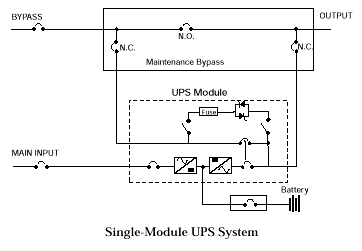
A large UPS system is typically provided with a static-switch bypass . If the UPS modules fail, the critical load will transfer to this bypass. Some designers also provide a wraparound maintenance bypass to the static switch, so as to isolate the UPS modules and static-switch bypass. However, the maintenance bypass provides unconditioned power to the critical load—with no stored energy reserve as backup.


In the event of a power loss—even for just milliseconds—the batteries associated with UPS modules provide the power to maintain continuity. If there is loss of power to the UPS module, the batteries will continue to provide power until their capacity is depleted and a low-voltage condition occurs. At that time the static bypass will transfer to a secondary source, if available and within voltage tolerances.


The Importance of Grounding

Tier-III installations are typically designed with N+1 modules — the total number of modules necessary to meet the load requirements, plus one additional module for redundancy — and are provided with a static-switch bypass to transfer power in the event of failure of the UPS modules. It is important that, if there is a problem with the UPS modules, the critical load transfers from UPS modules to static-switch bypass. In order for the transfer to occur, a good solid ground must be established.

Typically a ground wire is run, along with phase conductors, from the service substation to static-switch bypass. If the termination is not installed or maintained properly, an impedance may develop between the two reference grounds and cause increased voltage in the circuit phase conductors, pushing the tolerance range within which the bypass will transfer and causing the static switch to fail to transfer, even though a good secondary source is available.

It is vital that the ground is properly connected at the static-bypass cabinet, and zero potential is maintained at the neutral to ground bond at the static bypass and at the double-ended substation. Otherwise, the UPS system could fail to transfer to static bypass.

Most manufacturers recommend that a neutral and ground conductor be run from output isolation transformers from the UPS modules to static-switch bypass, where they will be connected to their respective bus. The neutral and ground should be bonded — in accordance with National Electrical Code (NEC) requirements — because the output of the transformers are separately derived systems. A ground is also run from the neutral and ground bond of double-ended substations to the neutral ground bond at the static switch. Because there is no transformer at the static switch to help establish a separately derived system, an electrically common point is established between the double-ended substation and static-switch bypass. This configuration, however, has the potential for creating problems with load continuity.


A major reason why data centers go off-line is human error. Where there is human intervention, there are potential problems with ground faults. Ground faults can be very difficult to predict and control and can cause havoc in large multi-module UPS systems. Smaller UPS systems — less than 225 kVA — have output isolation transformers with internal static-switch bypass. The output of the static-switch bypass and UPS is routed through a common output isolation transformer. This in turn protects the UPS system from ground faults and transients that may develop at the critical load.

On the other hand, UPS modules in larger systems typically have an output isolation transformer, but the static-switch bypass does not. If a ground fault occurs downstream from the UPS system but upstream from the power distribution unit, the fault will travel back to the source: the double-ended substation. To reach the source and help clear the fault, the load will transfer to the static-switch bypass. This can cause the main circuit breakers at the double-ended substation to trip on ground fault and take the critical load off-line. Because the breakers at the output of the static bypass and at the double-ended substations are approximately the same size, and are significantly larger than the minimum 1,000-amp setting allowed by NEC, it is possible that a facility's entire system will lose power.


Grounded Solutions

There are various solutions currently employed to help mitigate potential problems of ground faults and impedance between the two separately-derived grounds — at the static-switch bypass and the double-ended substation. A transformer can be installed at the input of the static switch so that the neutral-to-ground bond established at the static switch will come from a separate source.

This approach, however, can be costly, and the required transformer can be extremely large. Also, the transformer will contribute to inrush and additional impedance. But it may be of benefit in limiting maximum fault current available downstream from the UPS system.

Another popular solution is to implement high-resistance grounding. HRG is not commonly used on a low-voltage system. The intent is to introduce a resistor to limit the current that flows at the neutral and ground bond, where the ground-fault current transformer monitors fault current.


This method is difficult to implement, because it requires calculation of system capacitance and requires fine-tuning of the resistor in the field. It is also dangerous, requiring highly trained personnel to monitor the ground-fault alarm and then trace through the distribution system and isolate the source of the fault. Human error is already a major source of data center power loss. It does not seem a good idea to introduce yet more human intervention to trace and isolate fault current. In addition, the setting for the ground-fault sensors needs to be revisited any time a significant load is added that may change the system capacitance.

It may seem that the solution is as simple as providing a zone-interlocking relay-protection scheme from the double-ended substation down to UPS static switch, and a distribution switchboard downstream of the UPS system. But ground-fault coordination is very difficult to design and install. Also, the static switch will transfer from the UPS module at a much faster speed than any fast-acting relay.

It is essential to maintain operation of mission-critical facilities and data centers with a reliable distribution scheme. The design engineer should coordinate with the client to establish design parameters based on economics and level of required reliability for mission-critical facilities and ensure that the final product is a facility that meets all of the client's long-term operational requirement.


About the Blogger

Strategic Media Asia (SMA) is one of the approved CPD course providers of the Chartered Institution of Building Services Engineers (CIBSE) UK. The team exits to provide an interactive environment and opportunities for members of ICT industry and facilities' engineers to exchange professional views and experience.

SMA connects IT, Facilities and Design. For the Data Center Consideration Series, please visit 


(1) Site Selection,
(2) Space Planning,
(3) Cooling,
(4) Redundancy,
(5) Fire Suppression,

(6) Meet Me Rooms, and
(7) UPS Selection


Monday, September 22, 2014

Invitation to Data Center Technical Visit (2 Sites) + CPD Course in Critical Facilities and Data Center Design


2-days CPD Course in Data Center Facilities Design and Infrastructure Engineering (23 - 24 October 2014)

(HKIE CPD Course Code: CPD1029)


The course is designed for Building Services Engineers, Facilities / Data Center Managers, IT Management, etc. to enrich and update the knowledge in critical facilities and data centers design & build. It is more than a general introductory program for data center. Topics include:


- IT strategy
- Cabinet layout
- Raised floor system
- Data center network and structure
- Telecommunication backbones, redundancy, sizing and planning
- Fiber and optical system design
- Fiber and optical cable components
- Copper cabling components
- Copper system design and high speed ethernet
- Cable distribution, layout and management
- Earthing / grounding and bounding

- Power (1) – high / low voltage system, switch system, etc.
- Power (2) – UPS, transformers, fuel tanks, generators, etc.

- Cooling (1) – cooling topology, hot / cold aisle, etc.
- Cooling (2) – chiller, CRAC, cooling towers, etc.

- Environmental management system
- Physical security
- Fire protection system


Date: 23 - 24 October 2014 (Thursday - Friday)
Time: 10:00 – 18:00 (14 Hours)

Venue: 20/F, New Victory House, 93 - 103 Wing Lok Street, Sheung Wan, Hong Kong
(Very Near Exit A2, Sheung Wan MTR Station)

Fee: Special rate for HKIE's all membership classes


For details and syllabus, please refer to the CPD Course Calendar of Hong Kong Institution of Engineers, HKIE (http://www.hkie.org.hk/eng/html/cpd/cpdviewer.asp?sn=3248).

Kindly complete and return an Application Form together with a crossed cheque made payable to “Strategic Media Asia Limited” - Room 1605, 16/F, Causeway Bay Plaza 1, 489 Hennessy Road, Causeway Bay, Hong Kong.


Half Day Technical Visit to Data Centers in Kwai Chung and Tseung Kwan O (8 October 2014)


Sponsored by IXTech (www.hkcix.com) and HKCOLO (www.hkcolo.net)


Further to the critical facilities course, a half-day technical visit is targeted to provide an interactive environment and opportunities for members of IDC industry to exchange professional views and experience on TWO data center facilities (Tier II and Tier III+) and services. 


Date: 8 October 2014 (Wednesday)
Duration: 13:45 - 18:00
Assembly Time: 13:45 - 14:00
Assembly Point: Exit D, Kwai Fong MTR Station (Kwai Yan Road, Next to the Bus Stop)


Fee: HK$100, Round-trip transportation will be provided
(Waiver for the 2-day CPD course's participants)


For details of the technical visit, please visit 


Wednesday, July 30, 2014

Data Center Technical Visit


Again - Data Center Technical Visit

Sponsored by IXTech Limited
and Telehouse Hong Kong CCC (HKCOLO and KDDI Hong Kong)


We are pleased to announce that a Data Center Site Tour will serve for individuals who successfully attend our training seminars in Data Center Critical Facilities, Electrical and Air Conditioning System Design.

The Site Tour / Technical Visit targets to provide an interactive environment and opportunities for members of IDC industry to exchange professional views and experience on critical infrastructure and services.

It is also a rare chance to visit a world-class Tier III+ and a Tier II purpose-built data center facilities in Hong Kong during the same event.

For details, please visit the Site Tour Page and Rundown.


The Organizer

Strategic Media Asia (SMA) is one of the approved CPD course providers of the Chartered Institution of Building Services Engineers (CIBSE).

SMA is a critical infrastructure training, seminar and event organizer for corporations and professionals specialized in data center design & build, E&M facilities, structured cabling system, telecommunication, ICT and financial IT services.

For details of other data center courses and seminars, please visit our website at http://www.stmedia-asia.com/trainings.html.


Friday, July 25, 2014

Data Center Tier Levels and Uptime

The data center industry is laden with inter-related terms such as Uptime, Tier Levels, Availability, Redundancy and Reliability. In order to make an informed decision it is important to understand what they mean and what is the actual significance for any proposals you are considering in your analysis.


The concept of “Uptime” was pioneered by the Uptime Institute which was founded in 1993 and introduced its well defined Tier Classification system: I, II, III and IV, of which Tier IV represents the highest level of projected availability. Today, its Tier Certification system is globally recognized and its members are mostly Fortune 100-sized companies having multiple data centers averaging 50,000 square feet. And while not everyone subscribes to the Uptime Institute officially, marketing references to Tier 2,3 or 4 are common among those seeking to ascribe a certain level of design or construction to a data center’s overall availability or system redundancy, which may, or may not be totally accurate.


The terms “N, N+1 and 2N”, typically refer to the number of power and cooling components that comprise the entire data center infrastructure systems. Wherein “N” is the minimum rating of any component (such as a UPS, generator or cooling unit) required to support the critical load. An “N” system is not redundant at all, and the failure of any component will cause an outage, effectively describing a tier 1 type facility. N+1 and 2N, represent increasing levels of component redundancies and power paths, roughly mapping to the tiers 2-4, however it is important to understand that redundant components in themselves do not guarantee continuous availability, nor insure compliance with an Uptime Institute certified data center tier level.


Moreover, besides redundancy, the ability to do planned maintenance or emergency repairs on systems may involve the necessity to take them offline. This involves the key concept of “concurrent maintainability” which permits systems to be bypassed, without impacting the availability of the computing equipment. The Uptime Institute is well recognized in clearly defining concurrent maintainability in their Tier Level system. This is one of the key criteria in the design or certification of Tier III and Tier IV data centers.

Besides the level of infrastructure redundancy at the facility level, consistency of procedures for operations, maintenance and support of the critical infrastructure systems are key to ensuring continuous availability. Moreover, the Uptime Institute has now also established a related sub-category called Operational Sustainability to define and evaluate data center’s operational procedures, as an addition to their well recognized Tier Classification rating system.

Whether you chose to build or buy, you should examine all of these factors very closely to understand what is being promised if it is a brand new building and/or what the operating history of a proposed data center facility provider has been.


About Strategic Media Asia Limited

Strategic Media Asia (SMA) is one of the approved CPD course providers of the Chartered Institution of Building Services Engineers (CIBSE).

SMA, a critical infrastructure training and event organizer based in Hong Kong, provides an interactive environment and opportunities for members of IDC industry and engineers to exchange professional views and experience on critical infrastructure and E&M facilities.

For details of other data center courses and seminars, please visit our website at http://www.stmedia-asia.com/trainings.html.

Monday, May 27, 2013

Investing HK$2.8 Billion to Build a Largest Data Center in Hong Kong

One of the leading owners and operators of wholesale carrier neutral data center space in Europe and Asia-Pacific, Global Switch, has acquired a site on the Tseung Kwan O (TKO) Industrial Estate in Hong Kong to build a Tier III plus data center.

It intends to invest around HK$2.8 billion over the full course of the development, with further investment arising from specific customer requirements. This investment to build Hong Kong's largest data center is in response to strong customer demand, and is consistent with the strategy of expanding in key regional IT and connectivity hubs.

Once built the data center will offer 35,000 sq m (375,000 sq ft) gross space with 45MVA of utility power and have best-in-class environmental credentials targeting a LEED (Leadership in Energy and Environmental Design) Platinum Rating. Construction is planned to start in 2013, with the first phase of space becoming operational in Q1 2015.

The hosting services market in Asia Pacific is expected to grow by 10% to 15% CAGR over the next three to five years, on the back of strong economic growth, business expansion in the region, demand for disaster recovery facilities and corporations moving toward adopting cloud services. Hong Kong, as one of the key data center hubs in Asia, is expected to see strong demand in particular from the banking, financial services and insurance and trading and logistics sectors.