Are you struggling on where to start your energy efficiency efforts? Look to these
four key areas for improvements.
- Cooling: Typically the lowest hanging fruit.
- Water: Don’t overlook the use of water, due to its
scarcity in certain areas. Water is related to energy as well.
- Electrical Design: Recent engineering innovations offer new
efficient options.
- Incentives: Help offset improvement or development costs of
energy efficiency.
Measuring Efficiency
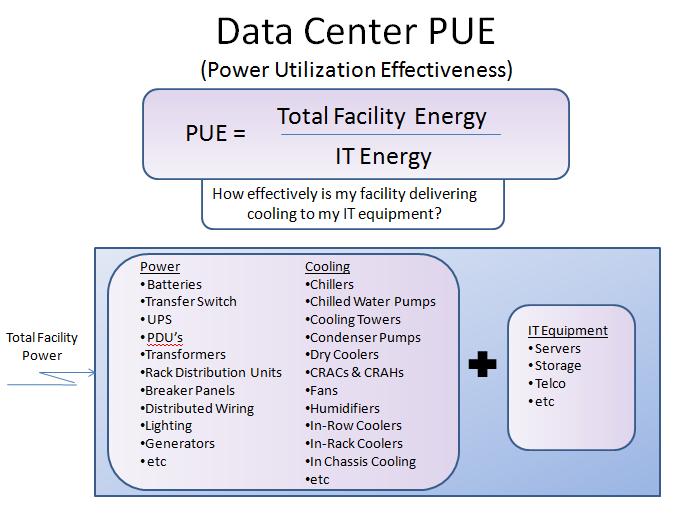
Power Usage Effectiveness (PUE) is the most popular industry metric for
measuring the energy efficiency of data centers. Today, there appears to be an
arms race for the lowest PUE. Even if you aren’t one of the select few with the
operational flexibility to participate, you can measure your PUE and work to
improve efficiency relative to your own data center site. The industry group,
The Green Grid, has many resources
available on PUE.
You may also consider to take some data center training / certification -
Energy and Cost Management for Data Center.
Green Cooling Techniques
ASHRAE’s
latest version of TC 9.9 drastically expanded the recommended and allowable
temperature and humidity ranges with the approval of the major server
manufacturers. It is estimated that an energy savings of 2-4% can be realized
for each degree Celsius the temperature is raised in a data center. It seems
raising the temperature is low hanging fruit, but I have seen very few do it to
date.
Another undisputed, easy and inexpensive energy saver is hot or cold aisle
containment. Preventing the mixing of cold and hot air results in a higher
return air temperature that yields an increased efficiency of the cooling
system. Many systems exist ranging from hard containment systems to simple
refrigerator curtains that you might see in a meat locker. Have a limited
budget? Hot or cold aisle containment provides a compelling financial argument
for adoption.
Free cooling is now a critical consideration–with either air-side or
water-side economization. The new temperature and humidity ranges offered by TC
9.9 make free cooling feasible for a large part of the year in any location, and
when designing a new data center or expanding an existing facility.
Liquid cooling has been talked about a great deal of late, with liquids being
far more efficient at expelling heat than air. The approach requires some
modification of the server so that it can be submerged in the liquid, but
studies have shown positive results.
Evaporative cooling is another energy efficient technique, especially
applicable in dry climates. However, evaporative cooling often sparks a debate
over the use of additional water, especially in water-constrained areas.
Water Efficiency
Water is a topic that is gaining increased attention and will continue to do
so in the future. I once heard a “futurist” say that “water is the new oil.” In
evaluating evaporative and other cooling techniques, many (myself included) have
made the mistake of evaluating only the amount of water used in the respective
cooling systems.
In order to determine the complete hydro-footprint of a system, you must also
look at energy usage and how much water is used in the production of that
energy. The
National
Renewable Energy Lab (NREL) published a study that analyzed how much water
is used in the production of power per kilowatt-hour on a state-by-state basis.
While not perfect, it provides a basis for analysis from an authoritative
source. After taking the amount of water used in the production of energy into
account in a particular geography, evaporative cooling can have a smaller
hydro-footprint (use less total water) than a chilled water system due to the
amount of energy saved.
There have been a few projects of late that use either sea water or ground
water for cooling, which is very efficient as it effectively eliminates the need
for much of the cooling equipment. A site in central Nebraska is pursuing this
tactic by using irrigation wells with a volume of 1,000 GPM at 52⁰F as the
source of groundwater for cooling and re-injecting the water back into the
aquifer. This is not only very energy efficient, but uses little to no water for
cooling, saving on both capital expenditures (CAPEX) and operating expenditures
(OPEX) through the elimination of much of the cooling equipment. The net impact
addresses both the energy and water efficiency of the equation for a very energy
efficient, and therefore sustainable, cooling solution.
Highly Efficient Electrical Solutions
Major efficiency gains have been made in recent years in electrical equipment
that can improve your data centers’ PUE. There are multiple manufacturers of
UPS’ that are reaching efficiencies of 96-98 percent at less than 50 percent
load. This is important if you utilize A and B feeds to your equipment for
redundancy.
Another trend is for the UPS to operate in a by-pass mode, which eliminates
the losses through the batteries. Many are not yet comfortable with this mode of
operation, but it is another efficiency gain to consider in optimizing
performance. Higher voltage and DC power are also evolving trends that provide
efficiency gains that bear mentioning.
Energy Efficiency Incentives and Rebates
Whether designing a new, energy efficient data center or upgrading your
existing facility, there are many incentives available to help defray the cost
and improve your ROI.
Power companies are commonly providing incentives based upon your performance
compared to a baseline building or a baseline piece of equipment. Plan to
include the power company as early in the design phase as possible, to maximize
the financial benefits. Some require approval of the incentive prior ordering
the equipment.
Additional Considerations
There are additional considerations beyond those mentioned above in
optimizing your mission critical facility’s efficiency.
- System modularity is an accepted practice that affects efficiency.
Implementing modular and rapidly expandable designs in lieu of installing full
density on day one typically results in higher efficiency through higher
equipment utilization. This saves on CAPEX and OPEX, making for a smart business
decision.
- Cogeneration, also known as combined heat and power (CHP), has gained in
popularity and can be as high as 60-80% efficient compared to the typical 30%
efficiency of normal power plants.
- Peak power shaving can also be achieved through thermal storage. This is
done by creating ice at night when power rates are lower and utilizing the ice
for cooling during the day.
Measure, Improve, Monitor and Repeat
Regardless of the selected energy efficiency measures in your new or existing
data center, make sure you measure your initial or existing condition so you
have a baseline. After your improvements are made, measure again to determine
your new condition and your ROI. In the case of a new data center, perform a
total cost of ownership (TCO) analysis to guide your decisions. You should
continue to monitor your efficiency and make improvements to improve your PUE
relative to your initial condition. As a reminder, measuring your outcomes
against those in the industry under different operating conditions may not
provide an apples-to-apples comparison.