Showing posts with label PUE. Show all posts

Tuesday, February 6, 2018

Learn Energy Audit for Mission-Critical Infrastructure (Program Developed by the U.S. Department of Energy)

Energy Monitoring?
Efficiency Improvement?
A comprehensive strategy to evaluate your critical infrastructure?


The data center industry and U.S. Department of Energy (DOE) partnered to develop a Data Center Energy Practitioner (DCEP) program which certifies energy practitioners to evaluate the energy status and efficiency opportunities in the mission-critical infrastructure worldwide.


The DCEP curriculum was updated in 2016 and formed collaboration with the industry to reinforce proven best practices and to introduce new tools and techniques in key areas such as IT equipment, air management, cooling systems, and electrical systems:-

Level 1 Practitioners ("Generalist", Day 1) will be expected to have a good understanding of 3 data center disciplines (HVAC - Heating, Ventilation and Air Conditioning, Electrical and IT-equipment) for providing broad recommendations based on the high-level DC Pro (Data Center Profiler) Tools.

Level 2 Practitioners ("HVAC-Specialist", Day 2 & 3) address HVAC energy opportunities using in-depth Air Management Assessment Tool.

Successful candidates who complete the 3-day program and pass the exams will gain Data Center Practitioner (DCEP) status by listing their names and contact information on the official website (http://datacenters.lbl.gov/dcep) as well as issuing certificates.


Level 1 Practitioners ("Generalist") - Day 1

- Generalist Training Introduction
- Data Center Profiler (DC Pro) Overview
- IT Equipment
- Air Management
- Cooling Systems
- Electrical Systems
- Assessment Process Manual
- Data Center Profiler (DC Pro) Case Study
- End of Generalist Training / Exam (2-hour, open-book exam)


Level 2 Practitioners ("HVAC-Specialist") - Day 2 & 3

- HVAC Specialist Training Introduction
- Air Handlers and Air Conditioners
- Liquid Cooling
- Chilled Water Plants
- Cooling System Controls
- Assessment Process
- Modeling Data Center HVAC Systems
- Environmental Requirements
- Airflow and Temperature Management
- DOE Air Management Tool
- End of HVAC Specialist Training / Exam (3-hour, open-book exam)

 
Official syllabus and program rundown -
http://datacenters.lbl.gov/resources/dcep-typical-training-agenda


Program Speaker

Dr. Bob Sullivan, a Worldwide Eminent Educator and a Data Center Infrastructure Specialist, is the concept creator of Hot Aisle-Cold Aisle. He is the winner of Data Center Dynamics 2016 - Outstanding Contribution to the Data Center Industry Award. TechTarget named Dr. Bob one of "five people who changed the data center" in August 13, 2010.


Exam and Certification

The Level 1 and Level 2 exams are open-book with multiple-choice questions following the training sessions. The result is either Pass or Fail. The passing score is 75%. There is a waiting period of 30 days to retake the exam(s).


Prerequisites to Gain the DCEP Designation (Level 2)

- 4 year technical degree with 3 years verifiable critical facilities design/operation experience; or
- 2 year technical degree with 6 years verifiable critical facilities design/operation experience; or
- 10 years verifiable critical facilities design/operation experience; and
- Completion of the 3-day instructor-led training; and
- Pass the exams of Level 1 and Level 2


Enrollment Details

Date: 16 - 18 May 2018 (Wednesday - Friday)
Time: 09:00 - 18:00
Venue: 19/F, New Victory House (OfficePlus), 103 - 93 Wing Lok Street, Sheung Wan, Hong Kong
Official Rate (3-day): US$2,900 (HK$22,800) per head


Course materials (in digital copy), examinations and applications fees are all included.
For enrollment and registration, please visit www.stmedia-asia.com/data-center-energy-practitioner-dcep.html.


Applications can be submitted online or by email. The copies of degree certificate(s) and projects / work experience / reference letters will be requested by the official Program Administrator (PA) in U.S.


"ANCIS Incorporated" is the Program Lead and authorised trainer of the Data Center Energy Practitioner (DCEP) program and "Strategic Media Asia Limited" is the approved program partner in Hong Kong for local administration.

Adverse Weather Arrangement - Events in the morning, afternoon or evening will be cancelled if typhoon signal No. 8 or above or black rainstorm warning is still hoisted after (or is announced by the Hong Kong Observatory to be hoisted at / after) 6:00 a.m., 11:00 a.m. and 4:00 p.m. respectively. Delegates will be notified when the class will be made up as soon as possible.


P.S. Think your team might also be interested? Pass it on ›


Strategic Media Asia Limited
Connecting IT, Facilities and Design

T (852) 2117 3893  |  F (852) 2184 9978

Room 403, 4th Floor, Dominion Centre, 43 - 59 Queen's Road East, Hong Kong
http://www.stmedia-asia.com  |  http://green-data.blogspot.com


Tuesday, March 28, 2017

The Latest Guide Targets Data Center Metering and Energy Use

Developed by the U.S. Department of Energy, the new guide is designed to implement a metering system for data centers. The metering system enables organizations to gather necessary data for effective decision-making and energy-efficiency improvements. The guide’s focus is on the necessary data calculating the power-usage effectiveness (PUE) metric.


Please download the whole guide from the Lawrence Berkeley National Laboratory, U.S. Department of Energy:

https://datacenters.lbl.gov/resources/data-center-metering-and-resource-guide


About the Blog


Strategic Media Asia (SMA) is one of the approved CPD course providers of the Chartered Institution of Building Services Engineers (CIBSE) UK. The team exists to provide an interactive environment and opportunities for members of ICT industry and facilities' engineers to exchange professional views and experience.

SMA connects IT, Facilities and Design. For Data Center Design Consideration, please visit 


(1) Site Selection,
(2) Space Planning,
(3) Cooling,
(4) Redundancy,
(5) Fire Suppression,
(6) Meet Me Rooms,
(7) UPS Selection, and
(8) Raised Floor

All topics focus on key components and provide technical advice and recommendations for designing a data center and critical facilities.


Wednesday, March 30, 2016

Four Monitoring Capabilities for Data Center Power Systems

The primary method that people use to measure the energy effectiveness of their data centers is power usage effectiveness (PUE). PUE compares the power used for computing capacity and the overall power used by the data center (PUE = Total Facility Power / IT Equipment Power). The inverse of PUE is data center efficiency, according to The Green Grid association.


Currently, the industry average PUE is reported to be around 2.0, but a number of new and proven data center infrastructure technologies are available to advance efficiency and reduce PUE to 1.5 or lower without compromising availability. There are 4 key actions data center managers can take with integrating monitoring capabilities into power systems that can help improve efficiency and advance PUE.


Monitoring Power Usage


With power densities and energy costs rising, the ability to monitor energy consumption is essential for advancing PUE. Where power is measured can have an effect on how efficiency is measured.

For a comprehensive picture of data center power consumption, power should be monitored at the UPS, the room power distribution unit (PDU), and within the rack. These data points should be consolidated and reported within an enterprise data center infrastructure management (DCIM) tool that can be shared by both facilities and IT management. DCIM tools (if specified early and fully integrated) can provide an overarching view of the data center, which will provide insights into how effectively or ineffectively the computing power of the data center is being used.


Specifically, measurements taken at the UPS provide a base measurement of data center energy consumption that can be used to calculate PUE and identify energy consumption trends. Monitoring the room PDU prevents overload conditions at the PDU and helps ensure power is distributed evenly across the facility.


The best view of IT power consumption comes from intelligent PDUs inside racks, which feature integrated monitoring and control capabilities to enable continuous power monitoring and feedback to the DCIM tool. Because rack power consumption varies based on equipment within the rack and its load, each rack should be equipped with a PDU—two for dual bus environments—capable of monitoring power consumption to the rack PDU, as well as overload-protected receptacle groups and, where required, at the receptacle level.


These systems can provide PDU, branch-level, and receptacle-level monitoring of voltage, kW, current, and kWh, giving the most direct measurement of power consumption and supporting higher data center efficiency and availability.


Monitoring Rack Conditions


With increasing densities, a single rack can now support the same computing capacity that used to require an entire room. Visibility into conditions in racks can help prevent many of the most common threats to rack-based equipment, such as accidental or malicious tampering.


If specified and installed correctly, rack monitoring units can be configured to trigger alarms when rack doors are opened, water or smoke is detected, or temperature or humidity thresholds are exceeded. Many units are equipped with cameras to capture video of the event. These “eyes inside the rack” can be connected to central monitoring systems where environmental data can be integrated with power data from rack PDUs, while providing local notification by activating a beacon or other alarm if problems are detected.


Monitoring Energy Efficiency


Automating collection and analysis of data from power systems can help reduce energy consumption while increasing IT productivity. Energy efficiency monitoring can track total data center consumption, automatically calculate and analyze PUE, and optimize the use of alternative energy sources.


Using real-time data from the many support systems, the monitoring system can track and trend total infrastructure power use and compare this to capacities. For example, for UPS power output, determine when UPS units are running at peak efficiency, and report Level 1 (basic) PUE. Monitoring at the room or row PDU provides the ability to more efficiently load power supplies, dynamically manage cooling, and automatically calculate Level 2 (intermediate) PUE. Panel board monitoring provides visibility into power consumption by non-IT systems, including lighting and generators, to ensure efficient use of those systems.


Finally, rack-level monitoring provides the most accurate picture of IT equipment power consumption and can support Level 3 (advanced) PUE reporting. The ability to automate data collection, and consolidate and analyze data related to efficiency—which is one of the primary jobs of the DCIM tool—is essential to data center optimization. These functions free up data center staff to focus on strategic IT issues.


Monitoring Batteries


Batteries have long been known as a weak link in the power chain. To prevent data loss and increase uptime, most data centers specify and require a dedicated battery monitoring system, which should be installed when the data center goes online. Using a predictive battery monitoring method can provide early notification of potential battery failure. The best practice is to implement a monitoring system that connects to and tracks the health of each battery within a string.


The most effective systems continuously track all battery parameters, including internal resistance, using a dc test current to ensure measurement accuracy and repeatability. Supported by a well-defined process for preventive maintenance and replacement, monitoring batteries can significantly reduce the risk of dropped loads due to battery failure, optimize battery life, and improve safety. The use of a battery monitoring system has an excellent payback period but, more importantly, provides peace of mind to the data center operator that the power system will react and support a load during a power outage.


INTELLIGENT CONTROLS


Previous generations of infrastructure systems were unable to adjust to dynamic load variations. UPS systems, meanwhile, operated most efficiently at full load, but full-load operation is the exception rather than the norm. The lack of flexibility in power systems led to inherent energy inefficiency.


Integrating intelligent control capabilities into data center power systems can help minimize the amount of energy being lost by enabling data center managers to tailor the performance of the UPS system to the specific efficiency and availability requirements of the site. When proper application of these capabilities is followed, it can enable double-conversion on-line UPS systems to operate at efficiency levels up to 97% while the inverter remains in operation.


Advanced UPS systems can employ an energy optimization mode that powers the load in reverse-transfer mode while keeping the UPS inverter at the ready to pick up the load in the event of a utility disturbance. An even higher degree of energy optimization provides power conditioning as well. The result is increased efficiency without compromising availability.


It is important that data center managers do not compromise on distribution and server power supply performance. Attention to distribution transformer and server power supply efficiencies can also reap huge benefits in improving PUE. Deploying TP1-rated distribution transformers can improve partial load efficiency by as much as 0.5%. High-efficiency server power supplies, while initially more expensive, can pay for themselves over their useful life.


About the Blogger


Strategic Media Asia Ltd (SMA) is one of the Approved CPD Course Providers of the Chartered Institution of Building Services Engineers (CIBSE). SMA exists to provide an interactive environment and opportunities for members of IDC industry and engineers to exchange professional views and experience on data center design, critical infrastructure system, electrical and mechanical facilities, etc.

SMA connects IT, Facilities and Design. For details, please visit our website at http://www.stmedia-asia.com/trainings.html.


Tuesday, June 25, 2013

Singapore continues to drive the demand for data centers

A majority or 78 percent of Singapore’s IT decision makers who participated in a recent survey plan to definitely or probably expand their data centers in 2013, with 82 percent planning for 2014. More than two thirds of the respondents who plan to expand this year prefer to locate their new data centers in Singapore as compared to other countries in the region. The research, conducted by Campos Analysis & Research on behalf of Digital Realty Trust, Inc., indicates that 83 percent will use a partner for design and build or to lease wholesale space, or both.

Of the Singapore-based respondents in the survey, 11 percent cited owning six or more data centers. Approximately 67 percent said they had built a new data centre in the past 24 months. Of those with plans to expand in 2013, 61 percent say they plan to expand in more than one location.

Commenting on the survey results, Kris Kumar, Senior Vice President and Regional Head of Asia Pacific for Digital Realty, said, “It is clear that Singapore’s data centre users are driving their expansion initiatives forward to manage the exponential growth in IT applications and data storage. With the high costs of individual new construction and the limited number of appropriate new sites, IT decision makers see the value of working with a data centre provider such as Digital Realty to fulfill these requirements.”


The average desired space and power requirements for data centre expansion initiatives are 14,000 square feet and 5.4kW per rack respectively. The research also indicates that the respondents’ need to track and manage data center power usage effectiveness (PUE) has increased over the last year. Most companies (80 percent) likely to expand in 2013 are extremely or very confident that they can comply with future energy (86 percent) or carbon emission regulations (82 percent).

“The continued focus on energy efficiency will drive change in the type of requirements customers have for their data centers,” explained Kumar. “This will highlight the capabilities of solution providers, such as Digital Realty, that can deliver data centre designs that are not only resilient, but also extremely efficient.”


Adopted from Networks Asia (www.networksasia.net)


Monday, February 18, 2013

Data Center CFD Modeling becomes user-friendly

Over the past several years, Computational Fluid Dynamics (CFD) modeling has proven to be a reliable method for optimizing the energy efficiency of the data center as well as accurately predicting the failure-mode conditions associated with cooling system failure.

For the past 30 years, CFD has been heavily used in industries such as aerospace and F1 racing, as the systems are complex, exotic and expensive. But things are beginning to change. Using advanced graphical user interfaces (GUIs) combined with a “SaaS” (software as a service) methods of application delivery, data center designers and facility managers are able to use the same technology to design data centers that the Ferrari F1 team uses to design its race cars, and at a much lower cost of entry. This approach greatly broadens access to this technology, which has been well proven in optimizing energy efficiency, reducing hot spots and accurately predicting cooling failure.
 

Benefits of CFD Monitoring

 
PUE Prediction
 
The energy to power a data center is composed of the power to drive the servers plus the power to cool the servers and any other ancillary devices such as PDUs, pumps and lighting. A common method for measuring the energy efficiency of a data center is PUE (power utilization effectiveness). The PUE of a data center is expressed in the relationship shown in Figure 1. A “good” data center is represented by a PUE of 1.2 or lower, suggesting that an additional 20% of the total power to operate the data center is powering non-IT equipment.
 
 
When reviewing the items that constitute the non-IT components of the calculations, the dominant parameters are related to the power required to drive the cooling systems. The role of CFD modeling in any of these designs is to insure that the cool air coming from the ducts, tiles or CRAH outlet reaches all the servers uniformly. This process of modeling the airflow and the resulting convective heat transfer is essential to the overall design and operation of a data center, particularly as it relates to failure-mode studies.
 
Cooling Failure Prediction
 
Failure model prediction is a key benefit that CFD modeling can provide. All cooling units need to be serviced periodically, and they completely fail occasionally. Predicting the thermal condition of the room ahead of the failure is vitally important to the data center operator. Knowing which servers will need to be shut down, or which cooling units are the most critical to the room, can be accurately and precisely predicted well in advance, and procedures can then be developed to follow in those cases.


What to Look for in a CFD Model

 
Here are some key factors to consider when seeking a CFD model:
 
  • User friendly: The last thing you need is another complex system—be sure to choose a model that is easy to use, is easy to understand and can be easy displayed to others (such as the C-Suite) who may not be as tech savvy.
  • Scalability: Be sure to choose a solution that will scale with you as new components (files, CRACs, racks, tiles, servers and so on) are added.
  • Cloud-Based: The cloud enables lower upfront investment, as it doesn’t require a dedicated server in your data center.
  • Flexible and Extensible: Be sure the system is flexible and extensible for integration with either upstream or downstream applications. For example, data from other DCIM applications can be fed directly into the system to speed model preparation.
  • Maximum Output: Look for a system that has options for output reports to ensure variety in how the information can be presented (graphs, charts, etc.). Every organization has its own methods, and this feature will benefit the usefulness of the data—it is meaningless unless it can convey the message to decision makers.

Adopted from http://www.datacenterjournal.com


Monday, July 23, 2012

Key Areas to Examine for Data Center Efficiency

Are you struggling on where to start your energy efficiency efforts? Look to these four key areas for improvements.

  • Cooling: Typically the lowest hanging fruit.
  • Water: Don’t overlook the use of water, due to its scarcity in certain areas. Water is related to energy as well.
  • Electrical Design: Recent engineering innovations offer new efficient options.
  • Incentives: Help offset improvement or development costs of energy efficiency.


Measuring Efficiency


Power Usage Effectiveness (PUE) is the most popular industry metric for measuring the energy efficiency of data centers. Today, there appears to be an arms race for the lowest PUE. Even if you aren’t one of the select few with the operational flexibility to participate, you can measure your PUE and work to improve efficiency relative to your own data center site. The industry group, The Green Grid, has many resources available on PUE.

You may also consider to take some data center training / certification - Energy and Cost Management for Data Center.


Green Cooling Techniques


ASHRAE’s latest version of TC 9.9 drastically expanded the recommended and allowable temperature and humidity ranges with the approval of the major server manufacturers. It is estimated that an energy savings of 2-4% can be realized for each degree Celsius the temperature is raised in a data center. It seems raising the temperature is low hanging fruit, but I have seen very few do it to date.

Another undisputed, easy and inexpensive energy saver is hot or cold aisle containment. Preventing the mixing of cold and hot air results in a higher return air temperature that yields an increased efficiency of the cooling system. Many systems exist ranging from hard containment systems to simple refrigerator curtains that you might see in a meat locker. Have a limited budget? Hot or cold aisle containment provides a compelling financial argument for adoption.

Free cooling is now a critical consideration–with either air-side or water-side economization. The new temperature and humidity ranges offered by TC 9.9 make free cooling feasible for a large part of the year in any location, and when designing a new data center or expanding an existing facility.
Liquid cooling has been talked about a great deal of late, with liquids being far more efficient at expelling heat than air. The approach requires some modification of the server so that it can be submerged in the liquid, but studies have shown positive results.

Evaporative cooling is another energy efficient technique, especially applicable in dry climates. However, evaporative cooling often sparks a debate over the use of additional water, especially in water-constrained areas.


Water Efficiency


Water is a topic that is gaining increased attention and will continue to do so in the future. I once heard a “futurist” say that “water is the new oil.” In evaluating evaporative and other cooling techniques, many (myself included) have made the mistake of evaluating only the amount of water used in the respective cooling systems.

In order to determine the complete hydro-footprint of a system, you must also look at energy usage and how much water is used in the production of that energy. The National Renewable Energy Lab (NREL) published a study that analyzed how much water is used in the production of power per kilowatt-hour on a state-by-state basis. While not perfect, it provides a basis for analysis from an authoritative source. After taking the amount of water used in the production of energy into account in a particular geography, evaporative cooling can have a smaller hydro-footprint (use less total water) than a chilled water system due to the amount of energy saved.

There have been a few projects of late that use either sea water or ground water for cooling, which is very efficient as it effectively eliminates the need for much of the cooling equipment. A site in central Nebraska is pursuing this tactic by using irrigation wells with a volume of 1,000 GPM at 52⁰F as the source of groundwater for cooling and re-injecting the water back into the aquifer. This is not only very energy efficient, but uses little to no water for cooling, saving on both capital expenditures (CAPEX) and operating expenditures (OPEX) through the elimination of much of the cooling equipment. The net impact addresses both the energy and water efficiency of the equation for a very energy efficient, and therefore sustainable, cooling solution.


Highly Efficient Electrical Solutions


Major efficiency gains have been made in recent years in electrical equipment that can improve your data centers’ PUE. There are multiple manufacturers of UPS’ that are reaching efficiencies of 96-98 percent at less than 50 percent load. This is important if you utilize A and B feeds to your equipment for redundancy.

Another trend is for the UPS to operate in a by-pass mode, which eliminates the losses through the batteries. Many are not yet comfortable with this mode of operation, but it is another efficiency gain to consider in optimizing performance. Higher voltage and DC power are also evolving trends that provide efficiency gains that bear mentioning.


Energy Efficiency Incentives and Rebates


Whether designing a new, energy efficient data center or upgrading your existing facility, there are many incentives available to help defray the cost and improve your ROI.

Power companies are commonly providing incentives based upon your performance compared to a baseline building or a baseline piece of equipment. Plan to include the power company as early in the design phase as possible, to maximize the financial benefits. Some require approval of the incentive prior ordering the equipment.


Additional Considerations


There are additional considerations beyond those mentioned above in optimizing your mission critical facility’s efficiency.
  • System modularity is an accepted practice that affects efficiency. Implementing modular and rapidly expandable designs in lieu of installing full density on day one typically results in higher efficiency through higher equipment utilization. This saves on CAPEX and OPEX, making for a smart business decision.
  • Cogeneration, also known as combined heat and power (CHP), has gained in popularity and can be as high as 60-80% efficient compared to the typical 30% efficiency of normal power plants.
  • Peak power shaving can also be achieved through thermal storage. This is done by creating ice at night when power rates are lower and utilizing the ice for cooling during the day.

Measure, Improve, Monitor and Repeat


Regardless of the selected energy efficiency measures in your new or existing data center, make sure you measure your initial or existing condition so you have a baseline. After your improvements are made, measure again to determine your new condition and your ROI. In the case of a new data center, perform a total cost of ownership (TCO) analysis to guide your decisions. You should continue to monitor your efficiency and make improvements to improve your PUE relative to your initial condition. As a reminder, measuring your outcomes against those in the industry under different operating conditions may not provide an apples-to-apples comparison.

Tuesday, April 17, 2012

Measuring Data Centre Efficiency by The Green Grid Tools

The Green Grid has finally released an online tool allowing data centre operators to compare efficiency, sustainability and resource consumption against the benchmarks set out in the Data Centre Maturity Model (DCMM).

The free-to-use tool will help measure various facets of a data centre, including power, cooling, compute, network and storage, and rate it against peers and industry best practices.

Measuring Green Credentials

In addition to the PUE / DCiE, the green Grid has also develop other metrics and benchmarks. "We developed the Data Centre Maturity Model to be the world’s most comprehensive single resource for setting data centre operators on the path to maximum sustainability and energy efficiency,” said Harkeeret Singh, the head of the Green Grid’s technical work group.

“The new online benchmarking tool builds on this work by providing users with clear assessment criteria that enables them to measure against current best practice, as well as a five year roadmap for the industry.”

While the Green Grid’s self-assessment tool will undoubtedly aid companies looking to improve their green credentials, it has taken more than a year after the DCMM was first announced for it to arrive. The previous method of measuring a data centre’s performance consisted of inputting information into a spreadsheet.

The industry consortium began testing the online tool last October, touting the inclusion of a “graphic equaliser” style feature.

“Once they have entered their data, users get access to their own personal DCMM equaliser, a model that enables them to determine their levels of maturity and identify the ongoing steps and innovations required as part of their strategy to achieve greater energy efficiency and sustainability improvements in the data centre,” Singh said.

“The Data Centre Maturity Model Tool will finally enable data centres to demonstrate credible proof that they leading the [IT] industry – and, perhaps, their rivals – in resource efficiency and sustainability.”

Adopted from http://www.techweekeurope.co.uk

Strategic Media Asia Limited is currently delivering an accredited training in Data Center Energy & Cost Management. The sysllabus is approved by The British Computer Society (BCS, www.bcs.org.uk) and the training content is largly related to The Green Grid Metrics, Measuring Power and Energy Consumption and Cost Control. You may find more informaiton from www.stmedia-asia.com/trainings.html


Monday, December 12, 2011

PUE & Cost Savings - Why go Green?

PUE and other efficiency measures on data centre are useful, but we more likely chasing the money now!
Efficient data centres have always made an effort to meet commercial needs – but the economic side of the movement may soon eclipse the “green” side, environmental issues and corporate image.

The move to the cloud is driving this. “Cloud-based services [like Facebook and Google], have the ability to build efficient data centres in locations where there is cheap power, and to highly utilise the IT equipment,” said Mark Monroe, executive director of the The Green Grid. “Their primary function is to drive the cost of a transaction down as low as it can be.”

The Green Grid has just had its annual European conference, over two days in Paris and London, and is reacting to this world, where it is all about the lowest cost for transactions. “Amazon can deliver a CPU-hour, for 10 cents,” said Monroe. He would have delivered the same measure for $3.75, two years ago, when he worked on Sun’s sustainable data centres.

It’s more about the money than the tech

The Green Grid has been known for the PUE measure of effiency, which has been picked up by various interantional bodies, and is regularly quoted for any new efficient data centre development.
At first sight, its other work looks like a continuation of that sort of effort, providing yet more ways for centres to measure their performance and compare themselves, including the still-under-development CUE and WUE measures of carbon-usage and water-usage respectively.

But alongside these measures, the group is coming up with a wide range of other material, which is increasingly designed to look hard-nosed, practical and, let’s face it, commercial.

Saving money, not PUE

The latest Green Grid White Paper surveyed members’ use of economisers, the cooling system which offers free air cooling and replaces the use of chillers.  Economisers trumpeted as a way to improve PUE. According to the survey, however, they do improve efficiency, but have no discernible effect on PUE.

“There was no statistically significant difference between the PUE reported by those who use economizers and by those who do not,” the report found.

They are taking off rapidly amongst Grid members, however, they save money. Around half the members surveyed are using economisers, and they are using them for almost all the hours allowed by the local climates (which turns out to be around 4,000 hours). They are doing so, because they are saving money – around 20 percent of the energy bill, with a payback time of around 20 months, according to Monroe.

Training program and Best Practices in Energy and Cost Savings for Data Centre

The British Computer Society is now launching an advanced certificate in Energy and Cost Savings in Data Centre. Strategic Media Asia is an Approved Training Provider in Hong Kong which is qualified to deliver such professional certificate training programme with Chartered Engineers (CEng). For more information and detailed syllabus, please contact (852) 3796 3026 or download brochure here.

Friday, December 9, 2011

Facebook Expands Green Open Hardware Push

The Open Compute Project is looking deeper into green data centres, from storage to systems management

If Facebook officials have their way, their Open Compute Project will go beyond servers and power supplies, touching on every aspect of a data centre’s infrastructure.

The initiative kicked off in April when Facebook open-sourced the server and data centre specifications the social networking giant employed in building its data centre in Prineville in Oregon. The project has since enrolled an impressive array of members, from Intel, Asus and Rackspace to Mellanox, Huawei and Red Hat, not to mention a few research and education institutions.

Spreading the initiative

It is an indication of the various directions in which the project is rapidly moving, Amir Michael, hardware design manager at Facebook, said in an interview with eWEEK during the recently concluded SC 11 supercomputing show in Seattle. Facebook is already moving forward with the next generation of the custom servers it has designed, Michael said.

At the same time, project members also are looking to tackle other aspects of the data centre, including systems management, storage and I/O. The push in these directions will help create the momentum to solve that key issues that Facebook officials saw when looking at data centre technology – that, in a broad way, proprietary products from large and small vendors alike could address some of the mainstream needs that are present in most enterprises, but often do not meet the unique demands a particular business may have.

Growing green roots

About two years ago, Facebook engineers set out  to start designing their own servers using standard off-the-shelf technologies. Up to that point, the company has been using systems from traditional OEMs. Facebook worked with chip makers Intel and Advanced Micro Devices, as well as systems makers Hewlett-Packard and Dell, to create the custom servers.

The aim was to build systems that offer the performance needed to run a fast-growing social network with 800 million-plus members while keeping down capital, power and cooling costs in the densely populated data centres. The Facebook-developed systems are 1.5U (2.65 inches) tall – rather than the more traditional 1U (1.5 inches) servers – which, among other positives, makes for better air flow and lower cooling costs, Michael said.

There is no paint or logos that are found on servers from OEMs – which not only reduces the capital costs, but also makes the systems lighter – there is a more energy-efficient power supply in place and they are easier to service, with tool-less components, from fans to power supplies.
The Oregon facility also uses outside air to keep the systems cool, rather than running expensive chiller units, Michael said.

Energy efficiency benefits

The result of the work was a 38 percent increase in energy efficiency at the Oregon facility at a lower cost of 24 percent as compared with Facebook’s other data centres, he said. The data centre also has a power usage effectiveness (PUE) ratio of 1.07. The PUE ratio is a way to measure how efficiently a facility uses its energy; the closer to 1.0, the better. The Environmental Protection Agency has a standard PUE rate of 1.5.

Facebook expects to get similar results as it builds new data centres, Michael said. Last month, company executives said they plan to build their next data centre in Lulea, Sweden, just on the edge of the Arctic Circle, to serve users inEuropeand other regions. The site was chosen for its cold air and access to hydroelectric power.

The company also is working on its next generation of servers, which will include such technologies as an Intelligent Platform Management Interface (IPMI) and the ability to reboot on the LAN. They also will continue to be powered by Intel and AMD chips, though Michael said the company also is keeping an eye on other chips, including those from ARM Holdings. ARM-designed chips from the likes of Nvidia, Qualcomm and Samsung are found in most smartphones, tablets and other mobile devices, but the company also is looking to move up the ladder and into low-power servers.

Adopted from http://www.eweekeurope.co.uk


Wednesday, December 7, 2011

Energy Efficient Data Centre, Realistically

Adopted from www.datacenterknowledge.com

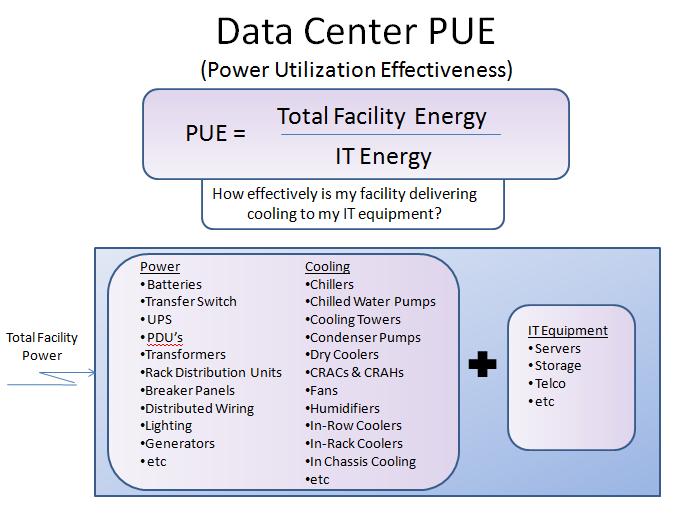
Power Usage Effectiveness (PUE) is one of the basic and most effective metrics for measuring data center energy efficiency. It is calculated by taking the total power consumed by a data center facility and dividing it by the power consumed by the IT equipment. The resulting ratio provides the effective power overhead for a unit of IT load. For example, a PUE value of 2.0 means that for every watt used to power IT equipment, an additional watt is required to deliver the power and keep the equipment cool. Data center managers are increasingly working to take measures to reduce PUE.

The PUE metric was introduced by the Green Grid, an association of IT professionals focused on increasing the energy efficiency of data centers. Green Grid also published the DCiE (Data Center Infrastructure Efficiency) metric. Both metrics measure the same two parameters, the total power to the data center and the IT equipment power.

PUE = Total Power into Datacenter/IT Equipment Power
DCiE = IT Equipment Power/Total Power into Datacenter

A PUE value of 1 depicts the optimal level of data center efficiency. In practical terms, a PUE value of 1 means that all power going into the data center is being used to power IT equipment. Anything above a value of 1 means there is data center overhead required to support the IT load.

Data Center Infrastructure Effectiveness (DCiE) is the reciprocal of PUE. It is calculated as a percentage by taking the total power of the IT equipment and dividing it by the total power into the data center multiplied by 100. A PUE value of 3.0 would equate to a DCiE value of 33%, or suggest that the IT equipment was consuming 33% of the facility’s power.


As stated above, in an ideal case scenario, all the power entering the data center should be used to operate the IT load (servers, storage and network). If we consider that all the power entering the data center is consumed for operating it, then the resultant PUE should ideally be 1. Realistically, however, some of this power is diverted to support cooling, lighting and other support infrastructure. Some of the remaining power is consumed due to losses in the power system, and the rest then goes to service the IT load.

Calculating PUE

Consider that the power entering the data center (measured at the utility meter) is 100 kW and the power consumed by the IT load (measured at the output of the UPS) is 50 kW, PUE will be calculated as follows:

PUE = 100 / 50 = 2.0

A PUE value of 2.0 is quite usual for a data center. It means that for every watt required to power a server, 2 watts of power is consumed. Since we pay for every watt of power entering the data center, every watt of overhead represents an additional cost. Reducing this overhead will reduce the overall operating costs for the data center.

The two ways in which we can bring about a change and improve data center energy efficiency include:

  • Reducing the power going to the support infrastructure
  • Reducing losses in the power system.

This way we can ensure that more of the power entering the data center should make it to the IT load; consequently, improving data center energy efficiency and reducing the PUE.

PUE Metric Is Not Always Ideal

Are there drawbacks to using PUE as a measurement of data center efficiency? Data center managers are under immense pressure to reduce costs and match the reported PUE with that of other companies. Unfortunately, this is not always the right approach and can have a negative impact. If data center managers focus only on reducing PUE, they may inadvertently use more energy and increase data center costs.

For example, a data center which has input power of 100 kW, 50kW of which is being used to power IT equipment. As previously illustrated, this would give us an initial PUE value of 2.0.

Suppose the organization now decides to virtualize some servers. In fact, it is so successful with virtualization that it is able to reduce the power to IT equipment by 25 kW and the overall power to the data center by the same amount. What happens to the PUE in such a case?
PUE (after virtualization) = 75 / 25 = 3.0

But isn’t this higher value what we want to avoid? Well, not necessarily. Let us understand the reason behind the increase or decrease in PUE value. While it may seem ambiguous, any reduction in IT usage will actually result in a higher PUE.

Here’s another formula for PUE:

PUE = IT Load + Infrastructure Load / IT Load = 1+Infrastructure Load / IT Load

Thus, when IT load is reduced, Infrastructure Load / IT Load will always increase, thereby, resulting in an increase in the PUE. Conversely, increasing the IT load will always decrease the PUE. So, if the PUE has gone up, does this mean the data center is now less energy efficient? On the contrary, the data center is now more energy efficient. We are able to do more with less now, that is, same work with less energy at a lesser cost.

Example of Virtualized/Unvirtualized Data Centers
Here’s an example using power pricing data from Maharashtra state in India.

Before virtualization:
Annual energy utilization = 100kW x 8760 hrs/yr = 876000 kWh
Annual electricity cost = 876000kWh x Rs. 3.10/kWh* = Rs. 27, 15,600
*Base Tariff for HT I – Industries – Mahadiscom

After Virtualization:
Annual energy utilization = 75kW x 8760 hrs/yr = 657000 kWh
Annual electricity cost = 657000 kWh x Rs. 3.10/kWh* = Rs. 20, 36,700
*Base Tariff for HT I – Industries – Mahadiscom

Considering that both data centers (both before and after virtualization) are able to perform the same amount of work, we can see from the above calculation that the virtualized data center is noticeably more energy efficient. In fact, the virtualized data center can be made even more energy efficient if the support infrastructure is now reduced to match the reduced IT load.

PUE becomes a meaningless number if we do not know how to use it to measure the outcome of changes in the data center. Knowing that virtualization will eventually increase the PUE of our data center, should we avoid it? No, infact when we examine the PUE of our data center over a period of time we should also take into account when the virtualization actually took place.

Other Variables in Energy Efficiency

We must track any changes that may have taken place in the IT infrastructure or IT Load in addition to tracking our PUE, so that we are able to correlate the changes to the PUE value. There are many other factors which may impact PUE. Redundancy, for example, will increase PUE. There will always be tradeoffs between availability and energy efficiency. Data center equipment – from cooling equipment to UPSs to server power supplies – will run more efficiently when they are heavily loaded.

The bottom line is that PUE, while an important piece of the energy efficiency puzzle, is just that – one piece of the energy efficiency puzzle. PUE constitutes only one component of a comprehensive energy management program which must consider both sides of the coin – the IT and the facility.


Data Centre Training in Energy Efficiency and Green Practices

Strategic Media Asia in Hong Kong is a leading events, seminars and trainings provider for data centre and telecommunication (ICT) industries. For more information, please visit http://www.stmedia-asia.com/ or download our event and training brochure.

Our Specialties and Event Topics Include:

Intelligient Building Systems
Design & Planning Telecom Network
Fibre Optic and Copper Cabling
Data Centre Design and Management
Data Centre Green Energy
Data Centre Audit and Compliance


Tuesday, December 6, 2011

The First Well-structured Green Data Centre Trainings in Hong Kong

Get ready to become a data centre energy specialist and prepare for an international data centre award in energy efficiency - CEEDA

Today, many organizations are looking for new ways of doing more with less, reducing IT budgets or curtailing the incidental costs associated with data center expansions. And data center managers need to focus on creating efficient operating environments to augment the life of existing data centers. Data center efficiencies can be attained through increasing compute densities, creating cold aisle containment systems or more effective use of outside air, but the key component over time is to have an easily understood metric to gauge data center efficiency, and how much improvement is taking place.

StrategicMedia Asia (SMA) provides any data centre and IT professionals with top level understanding of best practices in energy efficient data centre management from a series of 3 accredited certificate courses and training seminars (below) which focus on international green standard, financial and regulatory, facilities management, hardware management and software / system networks of Data Centre.

 Data Centre Facility and Infrastructure Engineering

The section is fundamental for executive and data centre owners, managers and operators to enrich their basic knowledge beyond the industry jargons and terminology. We provide a general introduction of the critical infrastructure system that supports typical Data Centres and environments. It also prepares you to fully understand the main components that facilitate Data Centre design & build, operation and management.

Green IT

The training provides a fundamental qualification for ICT engineers who are involved in creating sustainable and energy efficient data centre or exploiting the role of IT in helping deliver sustainable ICT operation and more efficient business practices to other areas of the organization. It also introduces different Green Standards such as ISO 14000 Series (Energy Measurement), Energy Star and PUE / DCiE (From The Green Grid).

Energy and Cost Management in Data Centre

This section explicitly deals with an organization's strategy as it relates to the effective use of energy by software, ICT systems and support infrastructure (mechanical and electrical systems) within the data centre. It will impart an understanding of the use and cost of energy in data centres with an appreciation of the contributing factors, awareness of best practices at a high-level and strategies to control and manage energy consumption and cost in data centres. Key area include:

Cost & Energy Monitoring and Reporting in Data Centre
How to Manage Energy and Cost
Interdisciplinary Teams’ Interactions and Communications
Energy Management and Energy Performance Efficiency
Efficiency Metrics
Metering
Reporting Energy and Carbon e.g. for CRC
Reporting Cost - The challenge of per cost accounting
The Roles for -
Estate Management, Facilities Management, Data Centre Manager,
IT Management, IT Analysts, Business Management


EU Code of Conduct in Data Centre

The training will impart an understanding of the purpose of the EU Code of Conduct and how to apply the Code's best practices at a high-level as well as helping you to develop a common language around energy efficiency. Key area include:

The reason of implementing best practice in the Code of Conduct
The bodies who use the EU Code of Conduct
Energy Measurement and Metrics
Best Practice - Interactions and Interdependencies
Best Practice - In detail

- Data Centre Utilization, Management and Planning
- IT Equipment and Services
- Cooling
- Data Centre Power Equipment
- Other Data Centre Equipment
- Data Centre Building
- Monitoring
- Practices to become minimum expected
- Items under consideration