Monday, February 18, 2013

Data Center CFD Modeling becomes user-friendly

Over the past several years, Computational Fluid Dynamics (CFD) modeling has proven to be a reliable method for optimizing the energy efficiency of the data center as well as accurately predicting the failure-mode conditions associated with cooling system failure.

For the past 30 years, CFD has been heavily used in industries such as aerospace and F1 racing, as the systems are complex, exotic and expensive. But things are beginning to change. Using advanced graphical user interfaces (GUIs) combined with a “SaaS” (software as a service) methods of application delivery, data center designers and facility managers are able to use the same technology to design data centers that the Ferrari F1 team uses to design its race cars, and at a much lower cost of entry. This approach greatly broadens access to this technology, which has been well proven in optimizing energy efficiency, reducing hot spots and accurately predicting cooling failure.
 

Benefits of CFD Monitoring

 
PUE Prediction
 
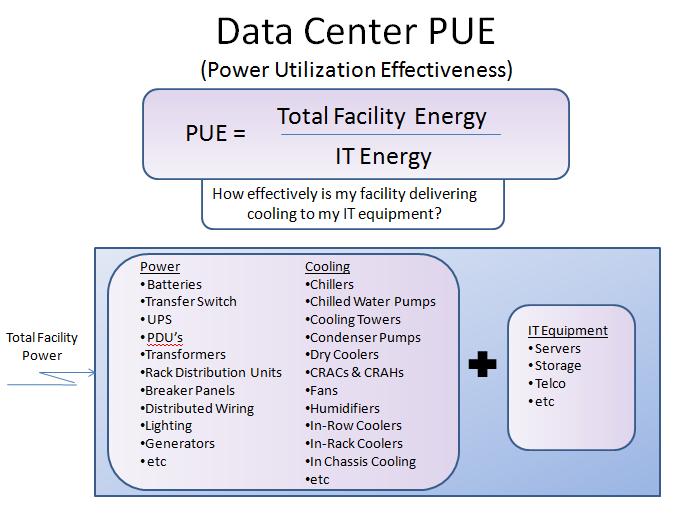
The energy to power a data center is composed of the power to drive the servers plus the power to cool the servers and any other ancillary devices such as PDUs, pumps and lighting. A common method for measuring the energy efficiency of a data center is PUE (power utilization effectiveness). The PUE of a data center is expressed in the relationship shown in Figure 1. A “good” data center is represented by a PUE of 1.2 or lower, suggesting that an additional 20% of the total power to operate the data center is powering non-IT equipment.
 
 
When reviewing the items that constitute the non-IT components of the calculations, the dominant parameters are related to the power required to drive the cooling systems. The role of CFD modeling in any of these designs is to insure that the cool air coming from the ducts, tiles or CRAH outlet reaches all the servers uniformly. This process of modeling the airflow and the resulting convective heat transfer is essential to the overall design and operation of a data center, particularly as it relates to failure-mode studies.
 
Cooling Failure Prediction
 
Failure model prediction is a key benefit that CFD modeling can provide. All cooling units need to be serviced periodically, and they completely fail occasionally. Predicting the thermal condition of the room ahead of the failure is vitally important to the data center operator. Knowing which servers will need to be shut down, or which cooling units are the most critical to the room, can be accurately and precisely predicted well in advance, and procedures can then be developed to follow in those cases.


What to Look for in a CFD Model

 
Here are some key factors to consider when seeking a CFD model:
 
  • User friendly: The last thing you need is another complex system—be sure to choose a model that is easy to use, is easy to understand and can be easy displayed to others (such as the C-Suite) who may not be as tech savvy.
  • Scalability: Be sure to choose a solution that will scale with you as new components (files, CRACs, racks, tiles, servers and so on) are added.
  • Cloud-Based: The cloud enables lower upfront investment, as it doesn’t require a dedicated server in your data center.
  • Flexible and Extensible: Be sure the system is flexible and extensible for integration with either upstream or downstream applications. For example, data from other DCIM applications can be fed directly into the system to speed model preparation.
  • Maximum Output: Look for a system that has options for output reports to ensure variety in how the information can be presented (graphs, charts, etc.). Every organization has its own methods, and this feature will benefit the usefulness of the data—it is meaningless unless it can convey the message to decision makers.

Adopted from http://www.datacenterjournal.com


Saturday, January 12, 2013

Worldwide Data Center Qualifications are going launch in Hong Kong with CNet Training, UK

Strategic Media Asia (SMA) believes each professional is different. This is a reason we provide more choices of training seminars and worldwide accredited courses in data center. Any of the seminars or courses will be bundled with a Data Center Technical Visit in Hong Kong every month.

  • Certified Data Center Management Professional (CDCMP)
  • Certified Data Center Design Professional (CDCDP)
 
Strategic Media Asia (SMA) is an authorised regional agent of CNet Training, UK (www.cnet-training.com) in Hong Kong, Macau and Great China.
 
For detail, please visit the official website of CNet Training http://www.cnet-training.com/course-locations/hong-kong/


Friday, December 21, 2012

Season's Greetings

With the festive season approaching, Strategic Media Asia, SMA would like to wish you a Merry Christmas and a prosperous 2013!


Wednesday, November 7, 2012

Green Data Center Engineers Certification Program


In the 2011-12 Policy Address and the 2012-13 Budget, the Government will thoroughly support the conversion of industrial buildings into data centers and the accommodation of data centers in Tseung Kwan O which attract capital investment from global institutions. SOE, a chartered institute for operations engineers, who expertizes in mission critical facility / services, supports the policy and launches a professional training program to the Data Centre and ICT Industries in Hong Kong.
 
The certified program provides a technical knowledge and “green theory” for engineers who are involved in creating sustainable and energy efficient data centre (E&M) / plants or exploiting the role of telecommunication in helping deliver green operation and business practices to other areas of organization such as Tendering & Procurement. It also introduces other efficiency metrics and international standards such as PUE/DCiE (The Green Grid Energy Measuring Tools), Carbon Footprint, TPL accounting, end-to-end life cycle cost, TCO, etc.
 
 
Program Outline
 
(1)       Introduction of Green Data Centre
(2)       Concepts and trends of Green Data Centre
(3)       SWOT analysis of Green Data Centre
(4)       Green elements and Risk Analysis of Green Data Centre
(5)       Green Implementation Plan
(6)       Building an effective Green Data Centre team
(7)       Evaluation life cycle cost for Green Data Centre
 
 
Venue: 
Society of Operations Engineers - Hong Kong Region
Unit 2, 3/F, Winsum Industrial Centre,
588-592, Castle Peak Road, Cheung Sha Wan, Kowloon, Hong Kong
 
Date: 
15, 19, 22, 26, 29 November
and 3, 6 December 2012 (Every Monday and Thursday)
 
Time:
07:00 pm – 10:00 pm
 
 
Certification: 
A certificate of "Green Data Centre Engineers" will be awarded for those participants who completed the course assessment OR CPD certificate will be issued to students with attendance over 70%.
 
 
Enquiry:
Please contact Ms. Connie Mui at 3188 0062 or email: connie@soe.org.hk or visit http://www.soe.org.hk/pdf/15112012/15112012.pdf for moreinformation.


Saturday, October 20, 2012

Data Center Site Tour / Technical Visit

Data Center Site Tour / Technical Visit
Data Center Site Tour
Sponsored by KDDI Hong Kong Limited (www.kddi.com.hk)

Overview

Strategic Media Asia (SMA) is pleased to announce that a Data Center Site Tour, organized by KDDI Hong Kong Limited (KDDI), will serve for individuals who successfully attend the training seminars in Data Center Facilities and HVAC Design.

Per normal practices, site tour only reserves for data center its own customers and will not open to the public. Therefore, it is definitely a rare chance for the selected participants from our Training Seminars to visit a world-class Tier 3+ purpose-built data center facility in Hong Kong.

For whoever who are interested in data center business and cooperation, SMA and KDDI will provide extra support to those companies in order to maintain the customers' satisfaction.


KDDI Hong Kong Limited

KDDI Corporation is a Fortune Global 500 companies and Top 10 Telecom Company in the World as of 2012.

Subsidiary company, KDDI Hong Kong was established in Hong Kong in 1988 and has over 20 years of experience in providing the One Stop Information Communications Technology (ICT) Solution to enterprises in Hong Kong such as providing Data Center Services, Content Delivery Acceleration (CDN), end-to-end Global Network, quality ICT Solutions and System Integration.

Through collaborative partnerships, KDDI has built up with telecommunications companies around the world in order to provide both a wide service area with high service quality. KDDI's backbone is a high-capacity fiber network that weaves the world together and its TELEHOUSE, which is an established global data center brand over the world.


For detail, please visit: www.kddi.com.hk


Telehouse Hong Kong CCC

TELEHOUSE HONG KONG CCC is one of the largest and most technologically advanced carrier neutral data center facilities in Hong Kong and in the Asia Pacific Region.

Telehouse Hong Kong CCC is a Tier 3+ purpose-built data center facility is strategically located in Tseung Kwan O, Hong Kong where around 19 km from the Central Business District and approximately 30 minutes from the Hong Kong International Airport. With virtually no risk of natural disasters in the vicinity, TELEHOUSE HONG KONG CCC is ideal for securing mission-critical business systems.

TELEHOUSE HONG KONG CCC service provides multinational corporations and local businesses in Hong Kong with neutral, secure and power-protected co-location facilities. It offers full end-to-end ICT Solutions from design to implementation such as IP connectivity, system integration, LAN and software installation, system monitoring and virtual servers as well as premium data centers.


For detail, please visit: www.telehouseglobal.com


Site Tour Details

Date 12 October 2012 (Full, next round will be arranged in Nov / Dec 2012)
Time 1:45pm - 5:00pm
Meeting Point Exit D, Kowloon Tong MTR Station (To Fuk Road, Transportation is provided)
Target Audience Data Center Operators, Consultants, Facilities Managers, E&M Engineers, Government / Corporates' IT Management, etc.
Fee Waived and Exclusive for Participants of Training Seminars
Enrollment Registration can be made during the training seminars or sent to info@stmedia-asia.com for reservation by 7 days before the Site Tour held
Remark Business Card and HKID Card (or Passport) are required for the on-site registration
Should you have any enquiry, please feel free to contact (852) 3796 3026 / info@stmedia-asia.com. Kindly visit our website (www.stmedia-asia.com) for further information.

General Guideline

- All visitors must submit full name (same as HKID) and working company to SMA for pre-registration
- All visitors must present their HKID and name card for on-site registration
- KDDI's representatives will conduct brief introduction and Q&A section before and after the Site Tour
- KDDI and SMA reserve the right to refuse any unexpected registration for the Site Tour
- In case of disputes, the ultimate decision will be reserved by KDDI and SMA

Courtesy Reminders :

- All visitors must wear and present their visitor passes during the Site Tour
- All visitors must return the visitor passes to the Reception Desk after the Site Tour
- Tour guides will accompany with all visitors during the Site Tour
- Smoking is prohibited
- Food and drinks are prohibited, except for designated dining area
- Photo taking and video recording are prohibited


© 2012 Strategic Media Asia Limited - Where IT, Facilities and Design Meet
T (852) 3796 3026 | F (852) 2184 9978 | www.stmedia-asia.com
Rm 1303, Leighton Centre, 77 Leighton Road, Causeway Bay, Hong Kong

Sunday, October 7, 2012

Energy Efficiency Certifications in Data Center

Striving for energy efficiency in your data center is not only a great way to reduce operating expenses and reduce the environmental impact of the facility, but it is a way to garner PR points as well. Energy efficiency certifications are a way to provide independent verification of your efforts, and although they can be “gamed,” they still provide some metric for a more objective evaluation of data centers.


What Your Certification Means

Whether you’ve earned an Energy Star, LEED, or some other certification, all you really have is an independent statement that your data center was at one time up to par according to a set of standards.

The very next day after receiving the certification—as far as anyone else knows—your facility may well have thrown all the energy efficiency measures out the window. Of course, when it comes to energy efficiency, that would make little business sense: lower energy consumption means lower operating costs. Furthermore, implementing energy-efficient practices often requires supporting infrastructure with its own capital costs, and not employing that infrastructure wastes the opportunity to recoup costs and even gain a return on the investment.


The following are several tips to consider for maintaining your certification.

  • Don’t make the certification your main goal.
  • Work toward the best efficiency you can achieve, not just the bare minimum for certification.
  • Keep track of changes in the certification standards.
  • Recertify as often as is practical.
  • Make energy efficiency an ongoing project, not just a task for the couple months before recertification time.
  • Stay informed about new energy efficiency technologies—and choose wisely among them.
  • Budget for energy efficiency.
  • Be honest about the meaning of certifications.

Adopted from http://www.datacenterjournal.com


Wednesday, September 12, 2012

Moving Away from Data Center Raised Floor - Benefits of Overhead Cabling

Low-Voltage Cabling Distribution

Interconnecting the various IT resources in a data center requires large amounts of cabling (whether fiber, copper or a combination of the two). Perhaps you have seen mess of wires and cables that can quickly build behind your desk, especially if you have a number of connected gadgets; the situation in the data center can be much worse if not carefully controlled. Finding a good place for cabling that permits good airflow, accessibility for maintenance and expansion, and safety (for personnel and equipment) is critical.


Benefits of Overhead Cabling

From an energy efficiency standpoint, overhead cabling eliminates one major source of airflow obstruction, helping reduce the likelihood of hot spots. According to an APC by Schneider Electric white paper (“How Overhead Cabling Saves Energy in Data Centers”), “The decision to place network data and power cabling into overhead cable trays can lower cooling fan and pump power consumption by 24%.”

But another major benefit is accessibility. Instead of being under the floor—and possibly all but inaccessible owing to the arrangement of equipment above the floor or the hassles of lifting floor tiles—overhead cabling can be entirely accessible, easing the process of maintaining existing cables or adding new ones. A TechTarget.com article (“Using overhead cables to tidy your data center: Ask the Expert podcast”) cites Robert McFarlane, a principal at consulting and technology design firm Shen Milsom and Wilke, as identifying another tremendous advantage: “avoiding the need to comply with article 645 of the National Electrical Code (NEC) and the dangerous Emergency Power Off (EPO) button that article requires.” The EPO button is a perennial source of headaches for data center operators: it has been mistaken for a variety of purposes, including a door opener, to the catastrophic detriment of data center uptime. Of course, McFarlane is referring to the use of overhead cabling for power cables in this context. But it is worth noting that the overhead cabling concept can also apply to power cables, delivering the same airflow and maintenance benefits on the facilities side as it does on the IT side.

Thus, if implemented properly, overhead cabling can improve both data center efficiency and uptime — a dual win. But the key is doing so in a way that avoids some common pitfalls.


Friday, August 10, 2012

Cloud Computing and Data Center Facilities Design

During the early days of data center design and management, facilities teams were able to run their own environments with only minimal interaction with other IT teams. Over the past few years, however, the sitution has been changed.


Impacts of Cloud


The effects of the cloud take numerous forms. When it comes to data center design and management, cloud computing can be a truly powerful tool. Consider the following:

  • Datacenter consolidation. With advancements in virtualization, IT facilities managers can now reduce the amount of physical data center resources that are directly in use. This means fewer servers and better resource utilization. This reduction in data center space can result in more intelligent computing and better cost management.

  • Monitoring and management. As a direct result of cloud computing, new monitoring and management tools have made the modern data center easier to control. Monitoring features are able to look at metrics such as workload balancing, server environmental statistics and even check for alerts and alarms. Working in a distributed environment settings has created the direct need for better management software. Facilities managers should take this into consideration and see how cloud-ready tools can help their environment.

  • Reconsidering HVAC. With a reduction in the physical footprint as a result of cloud computing and virtualization, facilities administrators are able to create a more efficient environment with better cooling and management practices. With cloud computing, there will be new requirements as far as how much environmental control will be required. This can be either a positive or negative, depending on the cloud approach. If a private cloud is being built onsite with new, integrated architecture, there may actually be a need for more cooling requirements, even if the footprint is less. On the other hand, offloading a cloud platform to a public provider can result in less cooling and power needs.

  • Disaster Recovery. A big benefit of cloud computing is the ability to replicate an entire data center to a remote facility (or numerous remote facilities). The other major consideration is the fact that these cloud-based DR data centers can be provisioned on demand with a pay-as-you-go model. This means facilities administrators won’t have to worry about their remote infrastructure until the time comes for a DR event. Of course, testing and constant monitoring of the secondary environment is always key.

  • On-demand computing. Instead of having systems being in a state of always on – facilities and IT teams can coordinate to ensure that a portion of that infrastructure is cloud-ready and provisioned only on demand. This means fewer data center components and less idle machines. More environments are looking to cloud providers to help them offload certain types of workloads and better their physical data center efficiencies.

  • Data management and warehousing. The conversation around “big data” is growing. More environments are seeking answers and solutions to how they can better manage their ever expanding database needs. Many times this means adding more shelves to a SAN and storing yet more data onsite. With cloud computing, facilities managers can leverage outside, WAN-based resources, to host some of their data needs. This means possible offloading or archiving massive amounts of data for quick retrieval, but making it all cloud-based.

  • Decentralizing the data center. Resiliency, redundancy and efficiency are always at the top of any facilities person’s list. A part of that process is to reduce single points of failure within a data center as well as making data more quickly to the end-user. With cloud computing, facilities can extend their environment and utilize more resources on-demand. This decentralized methodology can help offload hardware from an existing data center, create a more redundant system, and ensure that data can be placed closer to the end-user.

Thursday, August 2, 2012

Data Center Raised Floor and Cooling System

Data Center Executives are addressing the cooling infrastructure demands with a full line of airflow management and in-floor cooling solutions. The continued adoption of high density equipment, virtualization and cloud computing strategies requires the cooling infrastructure of a data center to be capable of adapting to high and often variable heat loads while offering superior energy efficiency.

There are line of in-floor cooling products for raised floor data centers can nearly eliminate by-pass air and save significant energy. Using directional airflow and variable-air-volume dampers, the data center can instantly react to any variation in utilization to match cooling with the heat load at the rack level. Some data center also provide fan assisted airflow to eliminate hot spots or implement high-density equipment in a current raised floor facilities without significant capital investment.

In addition, a full line of containment systems and air sealing grommets is designed to help reduce by-pass airflow, improve energy efficiency and increase data center capacity. More information can be found below.


Electronically controlled variable air volume damper used to adjusts the amount of air to meet the specific needs of the rack it services.


Fan assist module is designed to provide a blast of cooling through an individual airflow panel. This powerful solution is ideal for solving the toughest hot spots in a data center.


Grate panels the airflow angle toward the equipment achieving a 93% Total Air Capture (TAC) rate by a standard server rack.


Full line panels have the unmatched ability to handle heat density needs of the most demanding mission critical facilities.


Blade damper allows the user infinite airflow adjustability when it comes to airflow from any airflow panel.


Seal a variety of openings in the aisle, blocking bypass airflow and maximizing cooling performance.


The rack shield isolation system is designed to capture subfloor supply and dedicate it to the computer thermal load, thereby ensuring that cold supply air will not spill across the raised floor.


Hot and cold aisle containment, Partition, Strip Doors, Retracting Roofs, Hinged and Sliding Doors all work together to create the perfect containment solution.


The CRAC Hood Extension is a ceiling return duct that connects the top of the CRAC unit directly to a ceiling return plenum greatly increasing cooling capacity and efficiency by capturing hot exhaust air and channeling it directly into the CRAC unit.


Monday, July 23, 2012

Key Areas to Examine for Data Center Efficiency

Are you struggling on where to start your energy efficiency efforts? Look to these four key areas for improvements.

  • Cooling: Typically the lowest hanging fruit.
  • Water: Don’t overlook the use of water, due to its scarcity in certain areas. Water is related to energy as well.
  • Electrical Design: Recent engineering innovations offer new efficient options.
  • Incentives: Help offset improvement or development costs of energy efficiency.


Measuring Efficiency


Power Usage Effectiveness (PUE) is the most popular industry metric for measuring the energy efficiency of data centers. Today, there appears to be an arms race for the lowest PUE. Even if you aren’t one of the select few with the operational flexibility to participate, you can measure your PUE and work to improve efficiency relative to your own data center site. The industry group, The Green Grid, has many resources available on PUE.

You may also consider to take some data center training / certification - Energy and Cost Management for Data Center.


Green Cooling Techniques


ASHRAE’s latest version of TC 9.9 drastically expanded the recommended and allowable temperature and humidity ranges with the approval of the major server manufacturers. It is estimated that an energy savings of 2-4% can be realized for each degree Celsius the temperature is raised in a data center. It seems raising the temperature is low hanging fruit, but I have seen very few do it to date.

Another undisputed, easy and inexpensive energy saver is hot or cold aisle containment. Preventing the mixing of cold and hot air results in a higher return air temperature that yields an increased efficiency of the cooling system. Many systems exist ranging from hard containment systems to simple refrigerator curtains that you might see in a meat locker. Have a limited budget? Hot or cold aisle containment provides a compelling financial argument for adoption.

Free cooling is now a critical consideration–with either air-side or water-side economization. The new temperature and humidity ranges offered by TC 9.9 make free cooling feasible for a large part of the year in any location, and when designing a new data center or expanding an existing facility.
Liquid cooling has been talked about a great deal of late, with liquids being far more efficient at expelling heat than air. The approach requires some modification of the server so that it can be submerged in the liquid, but studies have shown positive results.

Evaporative cooling is another energy efficient technique, especially applicable in dry climates. However, evaporative cooling often sparks a debate over the use of additional water, especially in water-constrained areas.


Water Efficiency


Water is a topic that is gaining increased attention and will continue to do so in the future. I once heard a “futurist” say that “water is the new oil.” In evaluating evaporative and other cooling techniques, many (myself included) have made the mistake of evaluating only the amount of water used in the respective cooling systems.

In order to determine the complete hydro-footprint of a system, you must also look at energy usage and how much water is used in the production of that energy. The National Renewable Energy Lab (NREL) published a study that analyzed how much water is used in the production of power per kilowatt-hour on a state-by-state basis. While not perfect, it provides a basis for analysis from an authoritative source. After taking the amount of water used in the production of energy into account in a particular geography, evaporative cooling can have a smaller hydro-footprint (use less total water) than a chilled water system due to the amount of energy saved.

There have been a few projects of late that use either sea water or ground water for cooling, which is very efficient as it effectively eliminates the need for much of the cooling equipment. A site in central Nebraska is pursuing this tactic by using irrigation wells with a volume of 1,000 GPM at 52⁰F as the source of groundwater for cooling and re-injecting the water back into the aquifer. This is not only very energy efficient, but uses little to no water for cooling, saving on both capital expenditures (CAPEX) and operating expenditures (OPEX) through the elimination of much of the cooling equipment. The net impact addresses both the energy and water efficiency of the equation for a very energy efficient, and therefore sustainable, cooling solution.


Highly Efficient Electrical Solutions


Major efficiency gains have been made in recent years in electrical equipment that can improve your data centers’ PUE. There are multiple manufacturers of UPS’ that are reaching efficiencies of 96-98 percent at less than 50 percent load. This is important if you utilize A and B feeds to your equipment for redundancy.

Another trend is for the UPS to operate in a by-pass mode, which eliminates the losses through the batteries. Many are not yet comfortable with this mode of operation, but it is another efficiency gain to consider in optimizing performance. Higher voltage and DC power are also evolving trends that provide efficiency gains that bear mentioning.


Energy Efficiency Incentives and Rebates


Whether designing a new, energy efficient data center or upgrading your existing facility, there are many incentives available to help defray the cost and improve your ROI.

Power companies are commonly providing incentives based upon your performance compared to a baseline building or a baseline piece of equipment. Plan to include the power company as early in the design phase as possible, to maximize the financial benefits. Some require approval of the incentive prior ordering the equipment.


Additional Considerations


There are additional considerations beyond those mentioned above in optimizing your mission critical facility’s efficiency.
  • System modularity is an accepted practice that affects efficiency. Implementing modular and rapidly expandable designs in lieu of installing full density on day one typically results in higher efficiency through higher equipment utilization. This saves on CAPEX and OPEX, making for a smart business decision.
  • Cogeneration, also known as combined heat and power (CHP), has gained in popularity and can be as high as 60-80% efficient compared to the typical 30% efficiency of normal power plants.
  • Peak power shaving can also be achieved through thermal storage. This is done by creating ice at night when power rates are lower and utilizing the ice for cooling during the day.

Measure, Improve, Monitor and Repeat


Regardless of the selected energy efficiency measures in your new or existing data center, make sure you measure your initial or existing condition so you have a baseline. After your improvements are made, measure again to determine your new condition and your ROI. In the case of a new data center, perform a total cost of ownership (TCO) analysis to guide your decisions. You should continue to monitor your efficiency and make improvements to improve your PUE relative to your initial condition. As a reminder, measuring your outcomes against those in the industry under different operating conditions may not provide an apples-to-apples comparison.