Tuesday, August 5, 2014

Invitation to Data Centre World Asia 2014


Data Centre World Asia - The largest, most influential gathering of data centre expertise ever assembled in Asia working in partnership with Strategic Media Asia (SMA).


Date: Wednesday 29th and Thursday 30th October 2014, 9:30am-5pm
Location: Suntec Exhibition Centre, Singapore
Event Website: www.datacentreworldasia.com


Strategic Media Asia (SMA) is Data Centre World Asia’s Official Training Partner!


Data Centre World Asia, located in Singapore on the 29th & 30th October 2014, is largest, most influential gathering of data centre expertise ever assembled in Asia.

Data Centre World Asia includes an exhibition of 200 leading international suppliers as well as a world-class, case-study led conference programme with a number of dedicated theatres, containing 200 speakers and over 50 case studies focusing on best practice. All this practical content is worth $2000 SGD – and is available FREE of charge to SMA members who have this invitation.


Gain the latest insights from data centre thought-leaders, practitioners and visionaries including:

Johnson Tan, Director, Regional Head of Engineering Asia Pacific & Middle East, Barclays;
Anil Karmel, Co-Chair, National Institute of Standards and Technology;
Billy Lee Kok Chi, Chairman, Malaysian Data Centre Alliance;
David Blumanis, Vice President Data Centre Solutions and Key Account Management, Asia Pacific and Japan, IT Business, Schneider Electric;
Gavin O'Reilly, APAC Regional Head of Data Center Services, UBS;
Glenn Alann, Service Performance Manager Data Centres, National Bank of Australia;
Julian Kudritzki, COO, Uptime Institute;
Kris Holla, CSO, Data Center Products and Vice President, Nortek Inc., CES Group;
Manik Narayan, CIO – Asia Pacific & Japan, Global IT, SAP Asia Pacific;
Peter Rajaratnam, Head, Data Center Management, Prudential Services Asia to name a few...


Get practical advice from the 200 leading international suppliers including:

Dell, Huawei, Pacnet, Panduit, Kohler Power, Brocade, Digital Realty, Cicso, Mardix, TATA, SolidFire, Datwyler to name a few...


Whether you are already running and maintaining an advanced data centre, involved in initial projects or looking to improve or entirely re-shape your current data centre strategy, this is the one event you need to attend in 2014 – all completely FREE of charge.


Register now for your FREE tickets, worth over $2000 SGD at http://www.datacentreworldasia.com/SMA


Wednesday, July 30, 2014

Data Center Technical Visit


Again - Data Center Technical Visit

Sponsored by IXTech Limited
and Telehouse Hong Kong CCC (HKCOLO and KDDI Hong Kong)


We are pleased to announce that a Data Center Site Tour will serve for individuals who successfully attend our training seminars in Data Center Critical Facilities, Electrical and Air Conditioning System Design.

The Site Tour / Technical Visit targets to provide an interactive environment and opportunities for members of IDC industry to exchange professional views and experience on critical infrastructure and services.

It is also a rare chance to visit a world-class Tier III+ and a Tier II purpose-built data center facilities in Hong Kong during the same event.

For details, please visit the Site Tour Page and Rundown.


The Organizer

Strategic Media Asia (SMA) is one of the approved CPD course providers of the Chartered Institution of Building Services Engineers (CIBSE).

SMA is a critical infrastructure training, seminar and event organizer for corporations and professionals specialized in data center design & build, E&M facilities, structured cabling system, telecommunication, ICT and financial IT services.

For details of other data center courses and seminars, please visit our website at http://www.stmedia-asia.com/trainings.html.


Friday, July 25, 2014

Data Center Tier Levels and Uptime

The data center industry is laden with inter-related terms such as Uptime, Tier Levels, Availability, Redundancy and Reliability. In order to make an informed decision it is important to understand what they mean and what is the actual significance for any proposals you are considering in your analysis.


The concept of “Uptime” was pioneered by the Uptime Institute which was founded in 1993 and introduced its well defined Tier Classification system: I, II, III and IV, of which Tier IV represents the highest level of projected availability. Today, its Tier Certification system is globally recognized and its members are mostly Fortune 100-sized companies having multiple data centers averaging 50,000 square feet. And while not everyone subscribes to the Uptime Institute officially, marketing references to Tier 2,3 or 4 are common among those seeking to ascribe a certain level of design or construction to a data center’s overall availability or system redundancy, which may, or may not be totally accurate.


The terms “N, N+1 and 2N”, typically refer to the number of power and cooling components that comprise the entire data center infrastructure systems. Wherein “N” is the minimum rating of any component (such as a UPS, generator or cooling unit) required to support the critical load. An “N” system is not redundant at all, and the failure of any component will cause an outage, effectively describing a tier 1 type facility. N+1 and 2N, represent increasing levels of component redundancies and power paths, roughly mapping to the tiers 2-4, however it is important to understand that redundant components in themselves do not guarantee continuous availability, nor insure compliance with an Uptime Institute certified data center tier level.


Moreover, besides redundancy, the ability to do planned maintenance or emergency repairs on systems may involve the necessity to take them offline. This involves the key concept of “concurrent maintainability” which permits systems to be bypassed, without impacting the availability of the computing equipment. The Uptime Institute is well recognized in clearly defining concurrent maintainability in their Tier Level system. This is one of the key criteria in the design or certification of Tier III and Tier IV data centers.

Besides the level of infrastructure redundancy at the facility level, consistency of procedures for operations, maintenance and support of the critical infrastructure systems are key to ensuring continuous availability. Moreover, the Uptime Institute has now also established a related sub-category called Operational Sustainability to define and evaluate data center’s operational procedures, as an addition to their well recognized Tier Classification rating system.

Whether you chose to build or buy, you should examine all of these factors very closely to understand what is being promised if it is a brand new building and/or what the operating history of a proposed data center facility provider has been.


About Strategic Media Asia Limited

Strategic Media Asia (SMA) is one of the approved CPD course providers of the Chartered Institution of Building Services Engineers (CIBSE).

SMA, a critical infrastructure training and event organizer based in Hong Kong, provides an interactive environment and opportunities for members of IDC industry and engineers to exchange professional views and experience on critical infrastructure and E&M facilities.

For details of other data center courses and seminars, please visit our website at http://www.stmedia-asia.com/trainings.html.

Wednesday, June 25, 2014

4 Ways to Extend the Life of UPS Batteries

Data center backup power is a crucial element to uptime and availability. During an outage, Uninterrupted Power Supply (UPS) enables the switch from utility power to backup generator power. But there is a relatively unreliable and expensive variable to most UPS: batteries.

Batteries represent three evils: They are big, they are expensive, and they are expendable. Anything you can do to prolong the life of your batteries will indeed extend the availability of your data center.


So here are four ways that data center facility managers can extend the life of their UPS batteries.


(1) Buy the right UPS battery for your data center


In a data center, UPS is designed to fully discharge the battery source within 20 minutes. This is called high-rate discharge. High-rate batteries have thinner plates and more plates than lower-rate batteries, but as a result high-rate batteries can lead to a shorter lifespan.

There are many other factors in buying UPS batteries, such as the life expectancy, voltage, front or top access, flag post or inserted post, and other considerations. For example, a small format valve regulated lead acid (VRLA) battery has a relatively low first cost but lower reliability. Meanwhile, a nickel cadmium (NiCd) battery has the best reliability and longest service life, but the first cost can be four times as much as other batteries.

Data center manager must also be aware of potential manufacturing problems such as faulty post seal design and internal connection problems.


(2) Install, operate and maintain batteries correctly


Incorrect installation can lead to shortened battery life, as can improper maintenance. Good maintenance means giving the batteries well ventilated air that is as close as possible to 77 degrees Fahrenheit, and making sure that all batteries in the string are getting air within 3 degrees Fahrenheit to ensure that some of the batteries don't age more quickly than others.

Why? Mixing batteries of different ages or internal resistances can prompt batteries to die more quickly. Regular inspections of the batteries can unveil problems such as loose intercell connections and damaged post seals, which can lead to corrosion and even fires.

Data center manager should also be aware of the battery's discharge status as well. A fully or nearly fully discharged battery that isn't recharged within 48 hours can lead to damage. Overdischarging a battery can cause recharge problems, and excessive discharging -- for example, if a data center does weekly testing of its backup systems that includes battery cycling -- can reduce battery life.


(3) Monitor the UPS batteries' capacity


When the internal resistance of a battery rises due to normal aging factors such as corrosion, and when it has increased by as little as 30%, it's time to replace them. This is most often measured through capacity testing, as most manufacturers say that when a battery drops to 80% of its original capacity, it's cooked!

Users should perform capacity testing on their batteries based on IEEE standards; in particular, IEEE 1188 or IEEE 450.


(4) Flywheel UPS in conjunction with battery UPS


When flywheel UPS is installed with battery UPS, the flywheels can often handle the shorter power outages that happen more often and can prevent the batteries from cycling. The flywheel UPS also helps to extend battery life by two years preliminary.

In addition, flywheel can filter out the 'dirty power, such as little power blips and spikes. The batteries would filter those spikes out but if you hit the batteries with those spikes, it will kill the battery life.


About Strategic Media Asia Limited


Strategic Media Asia (SMA, www.stmedia-asia.com) is a professional training program and seminar organizer for corporations specialized in data center design & build, mission critical facilities, telecommunications infrastructure, financial IT and colocation services. Currently, SMA delivers a series of critical infrastructure training courses and qualification programs in Hong Kong and Macau.


For details, please visit www.stmedia-asia.com/trainings.html.


Wednesday, June 11, 2014

Preparatory Course - Become a Register of Specialist Contractors (Sub-register of Ventilation Works Category)

SMA is going to launch a new preparatory course which helps engineers / enterprises to facilitate compliance with the Buildings Ordinance and to become a Registered Contractors in Ventilation Works in Hong Kong.


Preparatory Course to Become a Register of Specialist Contractors
(Sub-register of Ventilation Works Category)


4th Round

Date: 31 January and 7 February 2015 (Saturday)
Time: 9:00 - 13:00 / 13:30
Venue: 14/F, On Lok Yuen Building, 25-27A Des Voeux Road Central, Hong Kong


This course is designed for ventilation and air-conditioning engineering company's Technical Director (TD), Authorized Signatory (AS) or other officers successfully becoming a registered specialist contractor (ventilation works category).

Participants will familiarize themselves with the Buildings Ordinance, ventilation and fire safety legislation, occupational safety and health and environmental protection, ventilation and air-conditioning and specialized knowledge, etc. within a short time and up to a professional standards of ventilation / air-conditioning engineer.


For syllabus and content, please visit our website:

Course Details (Chinese) or 
Course Details (English)

Please download the application at http://www.stmedia-asia.com/images/aircon.pdf


Tuesday, May 13, 2014

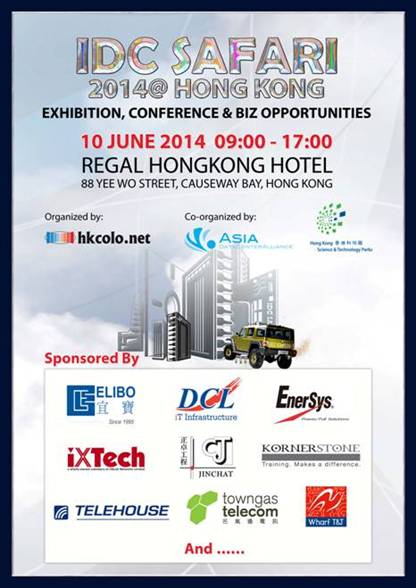
Invitation to IDC Safari Hong Kong 2014

IDC Safari

IDC Safari Hong Kong 2014

Date : 10 June 2014 (Tuesday)
Time : 9:00 a.m – 5:00 p.m
Venue : Regal Hong Kong Hotel
Address : 88 Yee Wo Street, Causeway Bay, Hong Kong

IDC Safari is a One-day IDC / Data Center Event organized by HKCOLO. Individuals, Companies, Institutions, Corporations, and Government Bodies which require IDC or related services will be invited to participate in the event. It targets to facilitate and provide an interactive business environment for all related and end-users to understand each others’ business requirements, exchange views, and to realize business opportunities and rooms for cooperation.

For registration details, please visit


OR


Wednesday, April 16, 2014

Data Center with Building Management System (BMS)

Most commercial buildings today integrate a number of different systems, ranging from power distribution to heating and cooling to physical security. Perhaps no facility is a better example than the data center which enables continuous operation of sensitive IT equipment and networks.

Keeping eyes on all the systems necessary for functioning a data center is virtually impossible unless you are using some form of management system.


Building Management System (BMS) with Data Center


Let's temporary ignore the networking and IT facilities, a typical data center must provide consistent, stable power, even in the event of a utility outage, as well as cooling, physical site security, lighting, fire suppression and other systems. Although many of these are common to a typical office building, their use in a data center requires added capabilities or special measures owing to the critical purposes. For instance, fire suppression should ideally enable extinguishing fires without destroying servers and other equipment.


Even with monitoring equipment in place, such as temperature and humidity sensors, power monitoring, various security measures and so on, it may be not practical to hire personnel to record the measurements or simply keep an eye on all these facilities. In this case, automation can be done through Building Management System (BMS).


A BMS handles the work of monitoring and recording data for various infrastructure systems. It also adjust the operation of these systems automatically to maximize the uptime and the operating efficiency. There are a few areas where building management systems can play an important role in the data center:


(1) Physical Security - A BMS can record who is entering secure areas of a facility via key cards or biometrics. Furthermore, it can implement various access-control measures, such as limiting access during certain times of the day or permitting certain personnel access to some areas but not others.


(2) Lighting Control - Servers may not need light to work, but people do. Unfortunately, owing to neglect or simply impracticality, lighting can become a major source of energy waste and thus decreased efficiency. A BMS can ensure that lights are shut off during off hours or when no motion is detected in a given area for some specified span of time.


(3) Efficient Cooling - As data centers move toward free cooling, air-side or water-side economizers and traditional mechanical cooling must function together in a manner that maximizes efficiency but still protects IT equipment. A BMS can balance these considerations. For instance, to run in economizer mode when the outside temperature is sufficiently low but to switch to CRAC units or water chillers when extra cooling is needed. If a hot spot develops, for instance, the BMS could increase air circulation at that point (if possible) or simply increase cooling to the appropriate area (or the entire facility).


(4) Power Distribution - Ensuring steady and clean power supply for the IT equipment is critical to keeping the data center running. A BMS monitors power conditions and provides alerts in the event of failure at some points in the power distribution system. In addition, the BMS can record data on power usage and conditions, enabling analysis for potential problems.


(5) Remote Monitoring Capability - When equipped with remote monitoring and alerts, the BMS can enable a facilities manager to keep an eye on conditions from another location—such as at home on a desktop computer or on the road via a laptop or tablet.


(6) Maintenance Scheduling - Data center maintenance is critical to keeping systems functioning. A BMS can indicate when infrastructure requires regularly scheduled maintenance, or when conditions merit preemptive maintenance to avoid a problem before it causes downtime. Automated maintenance reminders can prevent day-to-day tasks from causing employees and managers to forget periodic tasks that are necessary to the ongoing health of the facility.


(7) Enable Planning & Upgrades - The information that a BMS collects, in addition to providing a basis for maintenance and troubleshooting, can aid in planning for data center expansions or upgrades. For instance, power usage data relative to maximum capacity might indicate the need for greater capacity when additional IT equipment is installed.


(8) Improve Efficiency - Hardly the least concern of data center managers is increasing the efficiency of their facilities. Data collected by the BMS can be critical to determining which measures will increase efficiency and (potentially) by how much.


A building management system generally focuses on data center facilities. In some sense, a BMS could be considered a subset of the functions included in data center infrastructure management (DCIM). In the quest for greater integration and ultimate single-pane-of-glass monitoring and control of the data center, then, a BMS might be taken into account monitoring and controlling all aspects of the data center, including IT.


On the other hand, if you include IT functions in the scope of a BMS, then data center infrastructure management is simply a type of building management system specific to the needs of IT facilities.


Regardless of whether you differentiate DCIM from BMS, these systems illustrate the move of data centers toward greater integration of various systems and the centralized control and monitoring of the entire facility. A BMS enables data center managers to more promptly respond to problems as well as to identify, diagnose and address potential problems before they affect operations.


About Strategic Media Asia Limited


Strategic Media Asia (SMA, www.stmedia-asia.com) is a leading technical training and event organizer for corporations specialized in data center design & build, E&M facilities, telecom, ICT, finance and colocation. Currently, SMA delivers a series of data center trainings and qualification programs in Hong Kong, Taiwan and Macau.

All these events / training seminars are designed to support the leadership needs of senior executives (Chief Information Officers, IT Directors / Managers, Facilities Managers, company decision makers, etc.) and to provide useful and applicable knowledge.


Friday, March 21, 2014

Electrical Design for Mission Critical Supply Course


Within the built environment, mission critical facilities have particular power requirements that significantly impact how they are designed and operated.

We are pleased to introduce a new 2-day Program in Electrical Design for Mission Critical Supply. The course content is designed for data center operators, electrical & mechanical engineers, building services managers and infrastructure managers to enrich the relevant knowledge in power system design for mission critical facilities such as data center and other infrastructure.

The course details about the power system design and the components that support typical data centers or critical facilities. It prepares individual to fully understand data centers’ electrical design & build by exploring the international Standards and sharing the speaker’s experience.

You will understand the mission critical supply system, from power components to distributions and efficiency; from power requirements to designed, testing, commissioning and maintenance.


- Concept on primary supply and secondary supply
- Power flow in mission critical supply system
- Features of major equipment for critical supply

(1) Uninterrupted power supply and power storage
(2) Backup generator
(3) Automatic transfer switch
(4) Static transfer switch
(5) Isolation transformer

- Efficiency assessment
- Power quality review
- Configuration diagram of critical supply (N+1 / 2N) design & analysis
- Review of cable sizing to incorporate harmonics content
- Earthing system design
- Testing and commissioning requirements
- Brief of Systems Merging Appraisal Test (SMAT)


For details, please visit the course content at http://www.stmedia-asia.com/newsletter_6.html


The Organizer

Strategic Media Asia (SMA) is one of the approved CPD course providers of the Chartered Institution of Building Services Engineers (CIBSE).

SMA, a critical infrastructure training and event organizer based in Hong Kong, provides an interactive environment and opportunities for members of IDC industry and engineers to exchange professional views and experience on critical infrastructure and E&M facilities.

For details of other data center courses and seminars, please visit our website at http://www.stmedia-asia.com/trainings.html.


Thursday, March 13, 2014

Data Center Power System Design

Engineers should take a closer look at the different power strategies being used to distribute power, and how they impact the data center.

Alternating Current (AC) versus Direct Current (DC) is a battle that has been going on for more than a century and continues today in the data center industry. Although AC power is the standard, based on its potential for eliminating conversion losses and improving efficiency, many believe that DC power is the future of data center distribution. Still others believe that the same level of efficiency can be achieved with AC by using more efficient equipment with higher voltage distribution.

Electrical systems usually waste energy in the form of losses due to inefficiencies in the electrical equipment and distribution system. On average, the electrical distribution system losses account for 12% of the total energy consumed by the data center. For a data center with 2000 kW of IT load (2700 kW total load), that equates to an annual cost of USD$280,000


Power System Design Tips


So please review these six key items when planning a data center power distribution system:


  • Install or replace existing power and IT equipment with energy-efficient equipment
  • Review the proposed IT equipment to determine if the systems can operate on 240 V AC or 380 V DC
  • Review all the advantages and challenges of the different power systems
  • Determine how much of the existing infrastructure would need to be replaced to change power systems
  • Design flexibility into the power system that will allow the data center to adapt in the future
  • Design a power system that is modular to eliminate partial loading


Similar to the mechanical systems, modifications can be made to the electrical system to make it more efficient and save energy. The key to a good mission critical facility design is not to degrade the reliability of the facility in the process.


Typical Electrical Distribution Systems


Typical legacy data center electrical distribution system is made up of five major components:

Power is supplied to the data center at medium voltage from a utility/generator power source. The power is stepped down from medium voltage to distribution voltage by a substation transformer. The power then goes through an Uninterrupted Power Supply (UPS) system that conditions the power and provides ride-through capability during an outage until the generator starts. The power is then stepped down to substation voltage by a Power Distribution Unit (PDU). The PDU supplies power to the IT power supply where it is rectified and stepped down DC power, which is the internal operating voltage of the IT equipment.


Utility / Generator --MV AC--> MV/LV Transformers --480V AC--> Switchgear --480V AC-->
UPS --480V AC--> PDU --208/120V AC--> IT Power Supply --12V DC--> Servers


Four components in the legacy electrical distribution system with the highest losses are:


  • Substation transformer: Transformer no-load and core losses
  • UPS: Rectifier and inverter losses
  • PDU transformer: Transformer no-load and core losses
  • IT power supply: Rectifier and transformer losses


One method for increasing efficiency is to replace those pieces of equipment with more efficient equipment. Today with ultra-high-efficient transformers that efficiency is above 99.5%. Conventional double conversion UPS systems range from 84% efficient at 25% load to 94% at 100% load. Using flywheel or passive standby UPS topology can increase that range to 94% efficient at 25% load and 99% at 100% load.

Another method for increasing efficiency is to eliminate partial loading of the data center. Eliminating partial loading reduces losses by allowing the equipment to operate at its peak operating efficiency. This can be performed by designing a power system that is modular, grows with the load, or by designing a power system that uses flexible tiers, and matches the reliability and redundancy to the different programs within the data center.

A third method is to eliminate the inefficient electrical equipment altogether. Increasing efficiency by eliminating the equipment that has the most losses is the reason why different power strategies are being investigated for data center distribution.


About the Blogger

Strategic Media Asia (SMA) is one of the approved CPD course providers of the Chartered Institution of Building Services Engineers (CIBSE).

SMA, a critical infrastructure training and event organizer based in Hong Kong, provides an interactive environment and opportunities for members of IDC industry and engineers to exchange professional views and experience on critical infrastructure and E&M facilities.

For more details of other data center courses and industry events, please visit our website at http://www.stmedia-asia.com/trainings.html.


Thursday, February 20, 2014

Data Center Facilities Design and Infrastructure Engineering Course on 20 February 2014

Thanks for the participation. The captioned course is successfully launched at 10:00 a.m., 20 February 2014.

Data Center Facilities Design and Infrastructure Engineering (20 - 21 February 2014)
HKIE CPD course (CPD0227) with 14 CPD Hours

@ New Victory House, 93 - 103 Wing Lok Street, Sheung Wan, Hong Kong


About The Organizer


Strategic Media Asia (SMA, www.stmedia-asia.com) is a leading technical training and event organizer for corporations specialized in data center design & build, E&M facilities, telecom, ICT, finance and colocation. Currently, SMA delivers a series of data center trainings and qualification programs in Hong Kong, Taiwan and Macau.

All these events / training seminars are designed to support the leadership needs of senior executives (Chief Information Officers, IT Directors / Managers, Facilities Managers, company decision makers, etc.) and to provide useful and applicable knowledge.