Tuesday, May 13, 2014

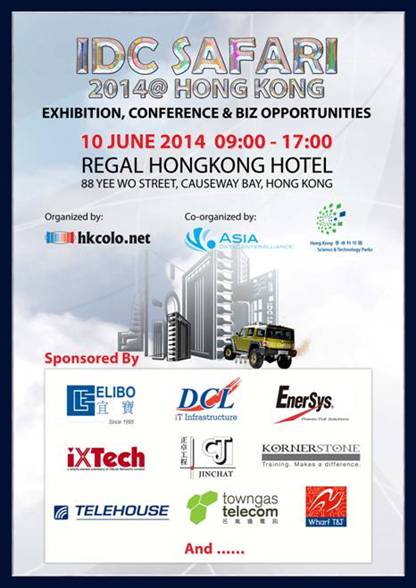
Invitation to IDC Safari Hong Kong 2014

IDC Safari

IDC Safari Hong Kong 2014

Date : 10 June 2014 (Tuesday)
Time : 9:00 a.m – 5:00 p.m
Venue : Regal Hong Kong Hotel
Address : 88 Yee Wo Street, Causeway Bay, Hong Kong

IDC Safari is a One-day IDC / Data Center Event organized by HKCOLO. Individuals, Companies, Institutions, Corporations, and Government Bodies which require IDC or related services will be invited to participate in the event. It targets to facilitate and provide an interactive business environment for all related and end-users to understand each others’ business requirements, exchange views, and to realize business opportunities and rooms for cooperation.

For registration details, please visit


OR


Wednesday, April 16, 2014

Data Center with Building Management System (BMS)

Most commercial buildings today integrate a number of different systems, ranging from power distribution to heating and cooling to physical security. Perhaps no facility is a better example than the data center which enables continuous operation of sensitive IT equipment and networks.

Keeping eyes on all the systems necessary for functioning a data center is virtually impossible unless you are using some form of management system.


Building Management System (BMS) with Data Center


Let's temporary ignore the networking and IT facilities, a typical data center must provide consistent, stable power, even in the event of a utility outage, as well as cooling, physical site security, lighting, fire suppression and other systems. Although many of these are common to a typical office building, their use in a data center requires added capabilities or special measures owing to the critical purposes. For instance, fire suppression should ideally enable extinguishing fires without destroying servers and other equipment.


Even with monitoring equipment in place, such as temperature and humidity sensors, power monitoring, various security measures and so on, it may be not practical to hire personnel to record the measurements or simply keep an eye on all these facilities. In this case, automation can be done through Building Management System (BMS).


A BMS handles the work of monitoring and recording data for various infrastructure systems. It also adjust the operation of these systems automatically to maximize the uptime and the operating efficiency. There are a few areas where building management systems can play an important role in the data center:


(1) Physical Security - A BMS can record who is entering secure areas of a facility via key cards or biometrics. Furthermore, it can implement various access-control measures, such as limiting access during certain times of the day or permitting certain personnel access to some areas but not others.


(2) Lighting Control - Servers may not need light to work, but people do. Unfortunately, owing to neglect or simply impracticality, lighting can become a major source of energy waste and thus decreased efficiency. A BMS can ensure that lights are shut off during off hours or when no motion is detected in a given area for some specified span of time.


(3) Efficient Cooling - As data centers move toward free cooling, air-side or water-side economizers and traditional mechanical cooling must function together in a manner that maximizes efficiency but still protects IT equipment. A BMS can balance these considerations. For instance, to run in economizer mode when the outside temperature is sufficiently low but to switch to CRAC units or water chillers when extra cooling is needed. If a hot spot develops, for instance, the BMS could increase air circulation at that point (if possible) or simply increase cooling to the appropriate area (or the entire facility).


(4) Power Distribution - Ensuring steady and clean power supply for the IT equipment is critical to keeping the data center running. A BMS monitors power conditions and provides alerts in the event of failure at some points in the power distribution system. In addition, the BMS can record data on power usage and conditions, enabling analysis for potential problems.


(5) Remote Monitoring Capability - When equipped with remote monitoring and alerts, the BMS can enable a facilities manager to keep an eye on conditions from another location—such as at home on a desktop computer or on the road via a laptop or tablet.


(6) Maintenance Scheduling - Data center maintenance is critical to keeping systems functioning. A BMS can indicate when infrastructure requires regularly scheduled maintenance, or when conditions merit preemptive maintenance to avoid a problem before it causes downtime. Automated maintenance reminders can prevent day-to-day tasks from causing employees and managers to forget periodic tasks that are necessary to the ongoing health of the facility.


(7) Enable Planning & Upgrades - The information that a BMS collects, in addition to providing a basis for maintenance and troubleshooting, can aid in planning for data center expansions or upgrades. For instance, power usage data relative to maximum capacity might indicate the need for greater capacity when additional IT equipment is installed.


(8) Improve Efficiency - Hardly the least concern of data center managers is increasing the efficiency of their facilities. Data collected by the BMS can be critical to determining which measures will increase efficiency and (potentially) by how much.


A building management system generally focuses on data center facilities. In some sense, a BMS could be considered a subset of the functions included in data center infrastructure management (DCIM). In the quest for greater integration and ultimate single-pane-of-glass monitoring and control of the data center, then, a BMS might be taken into account monitoring and controlling all aspects of the data center, including IT.


On the other hand, if you include IT functions in the scope of a BMS, then data center infrastructure management is simply a type of building management system specific to the needs of IT facilities.


Regardless of whether you differentiate DCIM from BMS, these systems illustrate the move of data centers toward greater integration of various systems and the centralized control and monitoring of the entire facility. A BMS enables data center managers to more promptly respond to problems as well as to identify, diagnose and address potential problems before they affect operations.


About Strategic Media Asia Limited


Strategic Media Asia (SMA, www.stmedia-asia.com) is a leading technical training and event organizer for corporations specialized in data center design & build, E&M facilities, telecom, ICT, finance and colocation. Currently, SMA delivers a series of data center trainings and qualification programs in Hong Kong, Taiwan and Macau.

All these events / training seminars are designed to support the leadership needs of senior executives (Chief Information Officers, IT Directors / Managers, Facilities Managers, company decision makers, etc.) and to provide useful and applicable knowledge.


Friday, March 21, 2014

Electrical Design for Mission Critical Supply Course


Within the built environment, mission critical facilities have particular power requirements that significantly impact how they are designed and operated.

We are pleased to introduce a new 2-day Program in Electrical Design for Mission Critical Supply. The course content is designed for data center operators, electrical & mechanical engineers, building services managers and infrastructure managers to enrich the relevant knowledge in power system design for mission critical facilities such as data center and other infrastructure.

The course details about the power system design and the components that support typical data centers or critical facilities. It prepares individual to fully understand data centers’ electrical design & build by exploring the international Standards and sharing the speaker’s experience.

You will understand the mission critical supply system, from power components to distributions and efficiency; from power requirements to designed, testing, commissioning and maintenance.


- Concept on primary supply and secondary supply
- Power flow in mission critical supply system
- Features of major equipment for critical supply

(1) Uninterrupted power supply and power storage
(2) Backup generator
(3) Automatic transfer switch
(4) Static transfer switch
(5) Isolation transformer

- Efficiency assessment
- Power quality review
- Configuration diagram of critical supply (N+1 / 2N) design & analysis
- Review of cable sizing to incorporate harmonics content
- Earthing system design
- Testing and commissioning requirements
- Brief of Systems Merging Appraisal Test (SMAT)


For details, please visit the course content at http://www.stmedia-asia.com/newsletter_6.html


The Organizer

Strategic Media Asia (SMA) is one of the approved CPD course providers of the Chartered Institution of Building Services Engineers (CIBSE).

SMA, a critical infrastructure training and event organizer based in Hong Kong, provides an interactive environment and opportunities for members of IDC industry and engineers to exchange professional views and experience on critical infrastructure and E&M facilities.

For details of other data center courses and seminars, please visit our website at http://www.stmedia-asia.com/trainings.html.


Thursday, March 13, 2014

Data Center Power System Design

Engineers should take a closer look at the different power strategies being used to distribute power, and how they impact the data center.

Alternating Current (AC) versus Direct Current (DC) is a battle that has been going on for more than a century and continues today in the data center industry. Although AC power is the standard, based on its potential for eliminating conversion losses and improving efficiency, many believe that DC power is the future of data center distribution. Still others believe that the same level of efficiency can be achieved with AC by using more efficient equipment with higher voltage distribution.

Electrical systems usually waste energy in the form of losses due to inefficiencies in the electrical equipment and distribution system. On average, the electrical distribution system losses account for 12% of the total energy consumed by the data center. For a data center with 2000 kW of IT load (2700 kW total load), that equates to an annual cost of USD$280,000


Power System Design Tips


So please review these six key items when planning a data center power distribution system:


  • Install or replace existing power and IT equipment with energy-efficient equipment
  • Review the proposed IT equipment to determine if the systems can operate on 240 V AC or 380 V DC
  • Review all the advantages and challenges of the different power systems
  • Determine how much of the existing infrastructure would need to be replaced to change power systems
  • Design flexibility into the power system that will allow the data center to adapt in the future
  • Design a power system that is modular to eliminate partial loading


Similar to the mechanical systems, modifications can be made to the electrical system to make it more efficient and save energy. The key to a good mission critical facility design is not to degrade the reliability of the facility in the process.


Typical Electrical Distribution Systems


Typical legacy data center electrical distribution system is made up of five major components:

Power is supplied to the data center at medium voltage from a utility/generator power source. The power is stepped down from medium voltage to distribution voltage by a substation transformer. The power then goes through an Uninterrupted Power Supply (UPS) system that conditions the power and provides ride-through capability during an outage until the generator starts. The power is then stepped down to substation voltage by a Power Distribution Unit (PDU). The PDU supplies power to the IT power supply where it is rectified and stepped down DC power, which is the internal operating voltage of the IT equipment.


Utility / Generator --MV AC--> MV/LV Transformers --480V AC--> Switchgear --480V AC-->
UPS --480V AC--> PDU --208/120V AC--> IT Power Supply --12V DC--> Servers


Four components in the legacy electrical distribution system with the highest losses are:


  • Substation transformer: Transformer no-load and core losses
  • UPS: Rectifier and inverter losses
  • PDU transformer: Transformer no-load and core losses
  • IT power supply: Rectifier and transformer losses


One method for increasing efficiency is to replace those pieces of equipment with more efficient equipment. Today with ultra-high-efficient transformers that efficiency is above 99.5%. Conventional double conversion UPS systems range from 84% efficient at 25% load to 94% at 100% load. Using flywheel or passive standby UPS topology can increase that range to 94% efficient at 25% load and 99% at 100% load.

Another method for increasing efficiency is to eliminate partial loading of the data center. Eliminating partial loading reduces losses by allowing the equipment to operate at its peak operating efficiency. This can be performed by designing a power system that is modular, grows with the load, or by designing a power system that uses flexible tiers, and matches the reliability and redundancy to the different programs within the data center.

A third method is to eliminate the inefficient electrical equipment altogether. Increasing efficiency by eliminating the equipment that has the most losses is the reason why different power strategies are being investigated for data center distribution.


About the Blogger

Strategic Media Asia (SMA) is one of the approved CPD course providers of the Chartered Institution of Building Services Engineers (CIBSE).

SMA, a critical infrastructure training and event organizer based in Hong Kong, provides an interactive environment and opportunities for members of IDC industry and engineers to exchange professional views and experience on critical infrastructure and E&M facilities.

For more details of other data center courses and industry events, please visit our website at http://www.stmedia-asia.com/trainings.html.


Thursday, February 20, 2014

Data Center Facilities Design and Infrastructure Engineering Course on 20 February 2014

Thanks for the participation. The captioned course is successfully launched at 10:00 a.m., 20 February 2014.

Data Center Facilities Design and Infrastructure Engineering (20 - 21 February 2014)
HKIE CPD course (CPD0227) with 14 CPD Hours

New Victory House, 93 - 103 Wing Lok Street, Sheung Wan, Hong Kong


About The Organizer


Strategic Media Asia (SMA, www.stmedia-asia.com) is a leading technical training and event organizer for corporations specialized in data center design & build, E&M facilities, telecom, ICT, finance and colocation. Currently, SMA delivers a series of data center trainings and qualification programs in Hong Kong, Taiwan and Macau.

All these events / training seminars are designed to support the leadership needs of senior executives (Chief Information Officers, IT Directors / Managers, Facilities Managers, company decision makers, etc.) and to provide useful and applicable knowledge.


Friday, January 24, 2014

Commissioning: Electrical System for Mission Critical Supply (3)

Refer to Previous post: Commissioning: Electrical System for Mission Critical Supply (2)


Generator Paralleling Switchgear

This is a crucial component to a critical facility in situations where the generator supported load exceeds the capacity of one generator.


Generator paralleling switchgear systems should be tested at the rated power factor of the generator paralleling switchgear system—typically 0.8. This is important to show that each generator properly shares the kW and kVAR loads. Just because paralleled generators evenly share kW while serving a resistive load does not always mean that they will evenly share kVAR when serving a reactive load.

A major challenge with testing generator paralleling switchgear systems is that they are often rated for very heavy loads due to the number of generators that can be connected to them. In some cases, it may not be practical and may also be very expensive to load generator paralleling switchgear systems to rated capacity.

It is recommended that enough load be provided so that it exceeds the capacity of one generator. Ideally, the load banks provided will be sized to the expected operational capacity of the generator paralleling switchgear, but not necessarily to its full design capacity.

Generator paralleling switchgear systems rely heavily on programming within the programmable logic controller (PLC) for operation. Knowledge of how this program operates is often limited to a handful of experts. Changes to PLC programming must be documented in a PLC programming change log. The log should include the date of the change, the reason for the change, a description of the change, and the new version number of the program that includes the change. Older versions of the program should be saved in the event that updates create additional problems and reverting back to an earlier version of the program is required.


Main Electrical Switchgear

It is also an important component to a critical facility because it distributes power to all of the downstream electrical distribution equipment.


Circuit breaker settings must be inputted, coordinated, tested, and verified throughout all main electrical distribution equipment. If there is a fault in the system, it is imperative that selective coordination is implemented so that the fault is isolated as far downstream as possible.

Main circuit breakers must be properly set up to ensure that they will stay closed during fault conditions and wait for downstream equipment to clear the fault. This will be ensured by implementing proper National Electrical Testing Association-recommended circuit breaker testing including instantaneous pickup, short time pickup, short time delay, long time pickup, long time delay, ground fault pickup, ground fault time delay, contact resistance tests, and insulation resistance tests.

While main electrical switchgear is an integral part of the electrical distribution system, the system’s current carrying capacity may increase the arc flash hazard. To avoid injury, main electrical switchgear should be disconnected before it is opened or worked on.

Because the owner will often not own a means of disconnect ahead of this equipment, it usually requires involvement from the utility provider, which can be problematic and difficult to schedule.


Static Transfer Switch (STS)

An STS is an important and useful component for a critical facility because it provides the ability to seamlessly transfer load during both failure and maintenance situations.


STSs behave similarly to ATSs, but because they are designed to transfer within a few msec, there are several settings that must be coordinated. STSs are commonly fed from UPS systems. These UPS systems are present to prevent interruptions to the downstream STSs. During a planned maintenance event or during a utility power failure, the UPSs are designed to perform transfers to bypass or battery within a certain time frame.

Because the STSs are set up to transfer on a loss of the primary source for a certain duration, the time frame must be longer than the allowable interruption seen from the UPS. If not coordinated properly, a routine transfer to bypass at the UPS level can cause the downstream STSs to transfer to their secondary source.

On several occasions, phantom voltage and current readings have been observed at the STS screens with no connected load. Rebooting the system typically corrects this problem. While the manufacturers generally indicate that there are no operational risks, this anomaly is puzzling.


Electrical Power Monitoring System (EPMS)

The EPMS allows all of the electrical systems within the critical facility to be monitored from a single location, giving the operator visibility to ensure that all systems are not generating any alarms and are operating properly and efficiently.

When confirming that the EPMS is monitoring systems correctly, multiple states must be checked for each point. Points must be modified in the field and checked to ensure that the same values or statuses observed in the field are properly reported back to the EPMS.

One difficulty encountered in this area has to do with discrepancies with points. Design engineers typically specify points to be monitored by the EPMS, but they often approve equipment submittals that are unable to provide these points. To avoid this problem, it is best to meet with the design engineer and the equipment manufacturers prior to the acceptance of the submittals to ensure that the points that are important to the design engineer can be provided by the equipment.


Conclusion

The equipment in the electrical distribution system of mission critical facilities must operate dependably. After commissioning challenges have been resolved and best practices have been employed, these systems will meet the original design intent and owner’s requirements, ensuring the owner that the facility embodies reliability, redundancy, and resiliency.


About The Blogger


Strategic Media Asia (SMA, www.stmedia-asia.com) is a leading technical training and event organizer for corporations specialized in data center design & build, E&M facilities, telecom, ICT, finance and colocation. Currently, SMA delivers a series of data center trainings and qualification programs in Hong Kong, Taiwan and Macau.

All these events / training seminars are designed to support the leadership needs of senior executives (Chief Information Officers, IT Directors / Managers, Facilities Managers, company decision makers, etc.) and to provide useful and applicable knowledge.


Commissioning: Electrical System for Mission Critical Supply (2)

Refer to Previous post: Commissioning: Electrical System for Mission Critical Supply (1)


Automatic Transfer Switch (ATS)

The ATS is an important component of the critical facility because it is used commonly in critical facility designs to transfer power from a primary source to a secondary source after the loss of the primary source.


Open transition ATSs are designed to allow for an interruption to the load using a break-before-make transfer. Because of this, loading the ATS during open transition transfers during functional performance testing is not required. Load is also not required when testing an ATS’s ability to perform closed transition transfers. During closed transition transfers, the ATS will parallel the primary and secondary sources prior to transferring.

It is important to ensure that the ATS can properly conduct closed transition transfers and will handle the transition in the same manner, regardless of whether it is carrying load or not. A power quality meter must be connected to the output of the ATS to confirm that the transfer is completed within the specified time for closed transition applications. It should be noted that load is required for all ATSs when conducting infrared scanning.

It is recommended that all components of the ATS are infrared scanned under full load on all primary, secondary, and bypassed power paths after final installation is complete. Load is also required for closed transition applications when the secondary source of the ATS is a generator. This testing is usually conducted as an integrated system test to prove that the generator and ATS work properly together under full load. The integrated system testing is conducted after functional performance testing for the ATS, generator, and other integral systems is completed.

In most cases, for an ATS to be functionally tested, both sources must be available because the ATS will usually inhibit any transfer if there is only one source. This problem can arise in situations where ATSs are added to existing live facilities. Because of their integral role in the power distribution system, they often can’t be tied into the electrical system without bringing down the loads that they will serve. In an effort to minimize disruption to the live facility, the ATS testing will likely occur prior to connecting it to the live facility.

However, the ATS can be connected to the secondary source if the secondary source is a generator. When the primary source serving the load is restored, there is usually limited time for testing the ATS as it will immediately be required to provide power to critical loads.


UPS

The UPS is a critical component to supporting critical loads, as it is the primary system responsible for maintaining continuity of load during a loss of utility. Courtesy: ESDThe UPS is probably the most important piece of equipment in the critical facility because of its ability to maintain power to critical loads, regardless of the operation of all of the other supporting systems.


Monitoring the inputs to the rectifier of the UPS, the static bypass within the UPS, and the UPS output bus is considered best practice during functional performance testing. After each transient, step load, or battery discharge test, the waveforms recorded by the power quality meters set up on the system should be reviewed to confirm that no events were triggered and that the output waveforms stayed within tolerance and recovered within the specified time frame.

UPS systems are often placed into service quickly after functional performance testing, so it is best to check the power quality meter results—including waveform captures—during on-site testing rather than waiting for a report from the meter technician. This way, any problem discovered during UPS testing can be quickly rectified as the manufacturer often has to consult the factory on problematic internal UPS operation.

Full load endurance tests should be conducted on UPS systems after the system has been installed on-site, even if full load testing was conducted in the factory. Many components need to be disconnected for shipping and are then reassembled on-site. Electrical equipment can also be affected by problems that develop during shipping and may not be detected without performing the endurance test on-site. Generally, an 8-hr duration for a full load test is considered adequate to confirm that the system will be capable of functioning at full rated load without problems.

In some cases, it can be difficult to monitor the logic used by the UPS to handle various operations because the actions are carried out by microprocessors installed on circuit boards. This emphasizes the importance of properly setting up power quality monitoring equipment prior to testing the UPS.

If a problem is detected during testing, the manufacturer will have a much easier time solving it if it is provided with significant data generated both by the UPS’s internal monitoring system and the external power monitoring equipment used during testing. When a failure occurs, it can be very difficult to understand what is happening inside the equipment. Captured test data almost always improves the issue resolution process.


Next Post: Commissioning: Electrical System for Mission Critical Supply (3)

Commissioning: Electrical System for Mission Critical Supply (1)

Critical Facilities Engineers should overcome the inherent challenges with functional performance testing for their electrical system.


The overall goal of commissioning must be to ensure that a facility meets the design intent and the owner’s requirements. For critical facilities, this goal is generally achieved by proving to the owner that the reliability, redundancy, and resiliency that he or she paid for is indeed present and operational in the finished facility.

Because there are so many failure scenarios and variables, it is rarely possible or cost efficient to reasonably test each one, but the commissioning authority has an obligation to provide a level of testing that will allow the owner to feel confident that each system is working and capable of maintaining a proper planned operational state during common external events.

As expected, the owner will want to use the commissioning process to be certain that the installation, performance, and operation of new equipment is acceptable before it supports critical load, and he or she will strive to do this as cheaply and as quickly as possible.

In the forthcoming posts, we will explores the best practices for testing several electrical systems, as well as some of the challenges encountered. Implementing these best practices and lessons learned on future projects will improve the quality of the product provided to the owner:


(1) Generator
(2) Automatic transfer switch (ATS)
(3) UPS
(4) Generator paralleling switchgear
(5) Main electrical switchgear
(6) Static transfer switch (STS)
(7) Electrical power monitoring system (EPMS)


Generator

Including the generators in the commissioning scope for a critical facility is imperative because they are the only source of long-term standby power when the utility becomes unavailable.


When testing a generator, it is best practice to ensure that the load for step loading and endurance testing has a power factor rating that matches the nameplate power factor on the generator, as the generator will be tuned and calibrated to operate best at its rated conditions. The manufacturer also will not likely be able to provide documentation on how the generator is expected to perform if the load used for testing deviates from the name plate conditions. The tuning and calibration is especially important when attempting a 0% to 100% step load, and often the system will not respond properly within acceptable tolerance if the power factor of the load does not match the nameplate rating.

Due to new some regulations in several countries, generators are now limited regarding the amount of pollution that they can emit under all running conditions, including when responding to step loads. This has been a challenge for generator manufacturers who in the past simply allowed the system to call for more fuel, which resulted in billows of black smoke entering the environment. In an effort to minimize pollution, manufacturers have had to finely tune the generators, resulting in the increased importance of testing the generators at rated power factor. In addition, because the generators are typically exercised under load for routine maintenance and testing, the owner often buys a permanent resisted load bank (unity power factor) sized for the rated capacity of the generator. It is important to explain to the owner that the permanent load bank that will be used for future load testing may not be appropriate to use during commissioning if it is rated at unity power factor.


Next Post: Commissioning: Electrical System for Mission Critical Supply (2)

Monday, December 30, 2013

Invitation to Data Center Technical Visit + CPD course in Critical Facilities Design

2-day CPD course in Data Center Facilities Design
and Infrastructure Engineering (20 - 21 February 2014)

(HKIE CPD Course Code: CPD0227)

The 2-day CPD course is designed for Building Services Engineers, Facilities / Data Center Managers, IT Management, etc. to enrich and update the knowledge in critical facilities and data centers design & build.

Topics include:

- IT strategy
- Cabinet layout
- Raised floor system
- Data center network and structure
- Telecommunication backbones, redundancy, sizing and planning
- Fiber and optical system design
- Fiber and optical cable components
- Copper cabling components
- Copper system design and high speed ethernet
- Cable distribution, layout and management
- Earthing / grounding and bounding
- Power (1) – high / low voltage system, switch system, etc.
- Power (2) – UPS, transformers, fuel tanks, generators, etc.
- Cooling (1) – cooling topology, hot / cold aisle, etc.
- Cooling (2) – chiller, CRAC, cooling towers, etc.
- Environmental management system
- Physical security
- Fire protection system


Date: 20 - 21 February 2014 (Thursday - Friday)
Time: 10:00 – 18:00 (14 Hours)
Venue: 20/F, New Victory House, 93 - 103 Wing Lok Street, Sheung Wan, Hong Kong

Fee: Special rate for HKIE's all membership classes


For detail and syllabus, please refer to the CPD Course Calendar of Hong Kong Institution of Engineers, HKIE (http://www.hkie.org.hk/eng/html/cpd/cpdviewer.asp?sn=2936) or contact (852) 2117 3893.

Kindly complete and return an Application Form together with a crossed cheque made payable to “Strategic Media Asia Limited” - Room 1605, 16/F, Causeway Bay Plaza 1, 489 Hennessy Road, Causeway Bay, Hong Kong.


Half Day Technical Visit to Data Center in Tseung Kwan O
TELEHOUSE HONG KONG CCC

Sponsored by KDDI Hong Kong Limited (www.kddi.com.hk)


Further to the HKIE CPD Course, the half-day technical visit targets to provide an interactive environment and opportunities for members of IDC industry to exchange professional views and experience on critical infrastructure / E&M facilities:


Date: 12 February 2014 (Wednesday)
Time: 13:45 - 17:15
Meeting Point: Exit D, Kowloon Tong MTR Station (Please refer to a rundown attached)

Fee: HK$100, Round-trip transportation will be provided
(Waiver for the CPD course's participants)


Remark:

Business Card and HKID Card are required for the on-site registration. KDDI Hong Kong reserve the right to refuse any unexpected registration for the Technical Visit. In case of disputes, the ultimate decision will be reserved by KDDI Hong Kong.


TELEHOUSE HONG KONG CCC


TELEHOUSE HONG KONG CCC (Telehouse Hong Kong Cloud Computing Complex) is one of the largest (360,000 sq.ft) and most technologically advanced carrier neutral data center facilities in Hong Kong and in the Asia Pacific Region.

Operated by KDDI Corporation, TELEHOUSE HONG KONG CCC is a Tier 3+ purpose-built data center facility that is strategically located in Tseung Kwan O, Hong Kong. With virtually no risk of natural disasters in the vicinity, TELEHOUSE HONG KONG CCC is ideal for securing mission-critical business systems.


About The Blogger


Strategic Media Asia (SMA, www.stmedia-asia.com) is a leading technical training and event organizer for corporations specialized in data center design & build, E&M facilities, telecom, ICT, finance and colocation. Currently, SMA delivers a series of data center trainings and qualification programs in Hong Kong, Taiwan and Macau.

All these events / training seminars are designed to support the leadership needs of senior executives (Chief Information Officers, IT Directors / Managers, Facilities Managers, company decision makers, etc.) and to provide useful and applicable knowledge.

Wednesday, December 18, 2013

Merry Christmas and Happy Year 2014

Season's Greetings - Merry Christmas and a happy, healthy and prosperous new year of 2014 from Strategic Media Asia Limited (SMA)